.jpg)
The Ultimate Guide to Building Up Jaw Muscles: Exercises for a Chiseled Jawline
_compressed.jpeg)
Why Building Strong Jaw Muscles Matters for Your Health and Confidence
Targeted exercises that strengthen the masseter, temporalis, and other key facial muscles can build up jaw muscles to improve jawline definition, chewing efficiency, and overall oral health.
Quick Answer: How to Build Up Jaw Muscles
- Jaw Clenching - Gently clench your teeth for 3-5 seconds, repeat 10 times
- Chin-Ups - Push your lower jaw forward, lift your lower lip, hold 10 seconds
- Vowel Sounds - Exaggerate "O" and "E" sounds with wide mouth movements
- Tongue Twister - Press your tongue to the roof of your mouth and hum
- Resistance Training - Open your mouth against gentle hand resistance
Frequency: Start with 10 repetitions per exercise, 1-2 sets daily
Your jaw muscles, including the masseter—one of the strongest in the body—work constantly as you eat and speak. However, modern diets full of soft, processed foods can cause these muscles to weaken over time. Research shows that between 5% and 12% of adults experience some form of jaw-related discomfort, often linked to underdeveloped jaw muscles.
Strengthening these muscles supports long-term oral health, improves your ability to chew properly, and can even help prevent certain types of facial discomfort. Studies have found that performing regular facial exercises for 20 weeks can lead to fuller cheeks and a more youthful appearance.
These exercises take just a few minutes and can be done anywhere, without special equipment. At Champaign Dental Group, our team understands that optimal oral health means caring for every part of your mouth. Our compassionate staff is here to guide you through exercises that are safe, effective, and custom to your individual needs.
Why a Strong Jaw Matters: More Than Just Looks
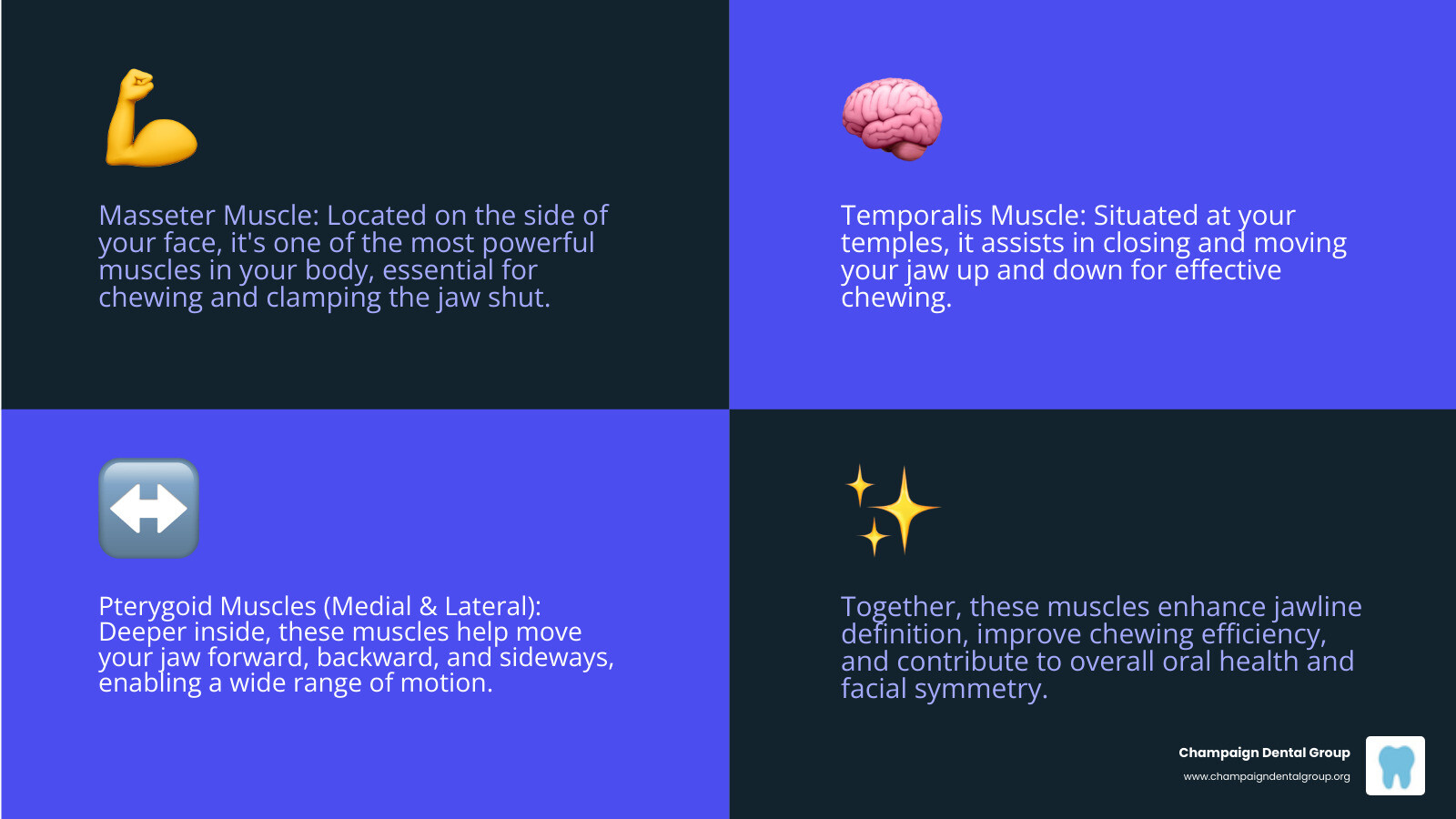
A strong jaw is about more than a chiseled appearance—it supports your daily life in crucial ways. Your jaw is powered by several key muscles that work as a team. The masseter muscle, running from your cheekbone to your lower jaw, is one of the body's strongest and powers your bite. The temporalis muscle at your temples lifts the jaw, while the deeper pterygoid muscles control forward, backward, and side-to-side movements.
When you actively build up jaw muscles, you gain real functional benefits. Improved chewing allows you to eat crisp or tough foods without fatigue, which aids digestion and stimulates saliva production—both crucial for supporting oral health. Stronger jaw muscles also contribute to speech clarity, helping you articulate words with confidence.
Aesthetically, a well-defined jaw improves facial symmetry and contributes to a youthful appearance. As we age, our skin loses elasticity and the jawline can soften. While genetics determine your natural facial structure, research suggests that consistent facial exercises can help tone the jawline and lead to fuller cheeks, helping you maximize your natural features.
Our modern lifestyle has also changed how our jaws develop. Today's diet of soft, processed foods doesn't challenge our jaws like the tougher foods our ancestors ate. This Research on facial morphology and nutrition shows how significantly diet can impact facial development.
Of course, your jaw structure depends on more than just exercise. To understand the foundation supporting these muscles, you can learn More info about your Jaw Bone. Factors like maintaining a healthy weight and practicing good posture also play supporting roles in how your jawline appears and functions. Strengthening your jaw muscles is a meaningful investment in your long-term oral health, facial function, and overall well-being.
How to Build Up Jaw Muscles: A Step-by-Step Exercise Guide
Starting a jaw exercise routine is like any other workout: it requires consistency, gradual progression, and listening to your body. The principle of progressive overload—gradually increasing the challenge over time—is key to strengthening your jaw muscles. The beauty of these exercises is that they require no special equipment and can be done anywhere.

Aim for consistency over several weeks to feel functional improvements and a few months for visible changes. Most importantly, if you feel sharp pain, stop immediately. Muscle fatigue is normal, but pain is a sign to rest.
Foundational Jaw Strengthening Exercises
These foundational movements are perfect for beginners. Start with 10 repetitions for 1-2 sets daily, gradually increasing as you get stronger.
- Chin-Up: Close your mouth, push your lower jaw forward, and lift your lower lip. Hold for 10-15 seconds to feel a stretch under your chin. Release and repeat.

- Vowel Sounds: Open your mouth wide to make an exaggerated "O" sound, then transition to an exaggerated "E" sound without closing your mouth. Repeat the O-E sequence 15 times.
- Tongue Twister: Press your entire tongue firmly against the roof of your mouth, just behind your front teeth. Create tension and hum for 2-3 seconds. Repeat 15 times.
- Collarbone Backup: Sit or stand tall. Gently pull your head straight back several inches while keeping it level. You should feel the muscles on the sides of your throat contract. Hold for a few seconds and repeat 10 times.
- Neck Curl-Up: Lie on your back with your tongue pressed to the roof of your mouth. Bring your chin to your chest and lift your head about 2-3 inches off the ground. Hold for a few seconds, then slowly lower. Be gentle with this movement.
Many of these exercises, like the Tongue Twister or gentle jaw clenching, can be done discreetly at your desk or in the car.
Advanced Techniques to Build Up Jaw Muscles
Once the foundational exercises feel easy, you can incorporate resistance. Remember to use controlled movements and proper form.
- Resisted Opening: Place your thumb under your chin and slowly open your mouth against the gentle resistance. Hold for 3-5 seconds, then close. Repeat 10-15 times.
- Resisted Closing: Place your thumb and index finger on your chin. Try to close your mouth against the gentle resistance of your fingers. Repeat 10-15 times to engage your powerful masseter and temporalis muscles.
- Jaw Jut: With your mouth closed, push your lower jaw forward so your lower teeth are in front of your upper teeth. Hold for 5-10 seconds and repeat 10-15 times.
While you may see jaw exercising products advertised, a report on jaw exercising products from 2024 found they had minor benefits, if any. We recommend focusing on these proven exercises. If you're considering any tools, the compassionate team at Champaign Dental Group can help you evaluate if they're right for you. Avoiding strain is crucial; stop immediately if you feel sharp pain.
Best Practices for Safe and Effective Jaw Training
Approaching jaw muscle training with the right strategy ensures better results while keeping your mouth healthy and comfortable. Just like any fitness routine, a proper warm-up and cool-down are essential.
Warm-Up and Cool-Down
A brief warm-up increases blood flow and prepares your muscles for work. Before you begin, try a few repetitions of gentle jaw opening, slow circular motions, and side-to-side glides.
After your workout, a cool-down helps maintain mobility and prevent stiffness. A few wide yawns (holding for 10 seconds) and gentle side-to-side stretches are excellent for this.
Frequency, Sets, and Repetitions
Consistency is your best friend. To effectively build up jaw muscles, we recommend starting with 1-2 sets of 10 repetitions for each exercise, once a day. As you get stronger over several weeks, you can gradually increase to 3 sets of 15 repetitions. The key is finding a rhythm that works for your schedule and sticking with it.
How to Build Up Jaw Muscles Without Causing Harm
Your safety is as important as your results. While jaw exercises offer great benefits, a mindful approach is essential to avoid setbacks. Follow these key guidelines:
- Listen to your body. Stop immediately if you feel any sharp pain, clicking, or unusual discomfort. Muscle fatigue is challenging, but it shouldn't hurt.
- Start slowly and progress gradually. Begin with gentle movements and fewer repetitions. Increase the intensity over several weeks to allow your muscles to adapt safely.
- Maintain proper form. Use a mirror when you're first learning the movements to ensure you're doing them correctly. Poor form limits results and can cause strain.
- Incorporate rest days. Your jaw muscles need recovery time to rebuild and get stronger, just like any other muscle group.
If you have a history of jaw discomfort or significant dental work like crowns or fillings, we strongly recommend checking in with our team at Champaign Dental Group before starting. Our compassionate staff can provide personalized advice custom to your unique oral health needs. We've been serving families in our community since 1997 and understand that everyone's mouth is different. For more detailed guidance, explore our resources on Jaw Exercises.
Your safety and comfort are our top priorities. With the right approach, you can confidently work toward a stronger, healthier jawline.
Supporting Your Jawline: The Role of Diet and Lifestyle
Jaw exercises are most effective when supported by the right nutrition and lifestyle choices. Just as you can't build strong biceps on a poor diet, your jaw muscles need the right fuel to grow stronger.
The Reality of Genetics, Aging, and Your Choices
Genetics determine your basic jaw shape, but you can absolutely influence its appearance over time. As we age, skin loses elasticity and fat can accumulate, softening the jawline. However, your lifestyle choices have tremendous power. Maintaining a healthy weight through a balanced diet and regular physical activity can make a remarkable difference in defining your facial structure.
Feeding Your Facial Muscles
Proper nutrition is essential for muscle health. Modern diets are often too soft, failing to provide the natural workout our jaws need. To build up jaw muscles, focus on these dietary habits:
- Eat Chewy and Crisp Foods: Incorporate chewy foods like lean meats and whole grains, and crisp fruits and vegetables like apples, carrots, and celery. These foods provide natural resistance, strengthening your jaw with every meal.
- Prioritize Protein: Adequate protein intake from sources like poultry, fish, beans, or nuts is crucial for muscle repair and growth.
- Stay Hydrated: Proper hydration helps your muscles work more efficiently and recover faster.
- Limit Processed Foods: Reducing foods high in sugar and sodium can help minimize bloating and better reveal your jawline definition.
The Surprising Connection Between Posture and Your Jawline
How you hold your head and shoulders affects your jawline's appearance. Poor posture, especially the forward head position common from screen use, creates tension in your neck and jaw. Standing and sitting tall with your head properly aligned over your shoulders naturally creates a more elongated, defined look in your neck and jawline.
At Champaign Dental Group, our compassionate team looks at the whole picture—not just your teeth, but how your jaw functions and how your diet and lifestyle fit together. We've seen how small, consistent changes can transform not just smiles, but overall facial health and confidence for the Champaign community we've served since 1997.
Frequently Asked Questions about Jawline Exercises
Our team at Champaign Dental Group often gets questions about jaw exercises. Here are some honest answers from the team that has provided compassionate, high-quality patient care to the Champaign community since 1997.
Can jaw exercises help reduce a double chin?
Jaw exercises are excellent for strengthening the underlying muscles in your neck and chin. This creates a firmer, more toned foundation which can help reduce the appearance of a double chin. However, these exercises do not directly burn fat. For the best results, we recommend combining jaw exercises with a balanced diet and an overall fitness routine to address both muscle tone and any excess fat.
How long does it take to see results from jaw exercises?
Patience and consistency are key. You may start to feel functional changes, like a stronger bite, within a few weeks. Visible definition, however, typically takes longer—often 3 to 6 months of consistent practice, depending on your genetics and dedication. As some research indicates, overall facial toning can be seen after about 20 weeks of regular exercise.
| Type of Result | Expected Timeline |
|---|---|
| Muscle engagement | 2-4 weeks |
| Increased strength | 4-8 weeks |
| Visible definition | 3-6 months (or more) |
| Overall facial toning | 20 weeks (as per research) |
Focus on consistency, and small improvements will add up over time.
Is it safe to do these exercises if I have dental work like crowns or fillings?
This is a crucial question. If you have crowns, fillings, veneers, or other dental work, we strongly encourage you to consult with our team at Champaign Dental Group before beginning any new routine. Our experienced, compassionate staff provides the high-quality, individualized patient care we're known for.
Gentle exercises that use your body's own resistance—like tongue presses and vowel sounds—are generally safe. They create mild engagement without putting excessive pressure on your teeth. However, high-resistance tools or forceful biting exercises can pose a risk to your dental work. We can evaluate your specific situation and provide a safe, custom exercise plan to help you build up jaw muscles while protecting your dental investments. Your health and confidence are our priority.
Conclusion: Sculpting Your Jawline and Supporting Your Smile
You now have a roadmap to build up jaw muscles for a healthier, more confident smile, from understanding the key anatomy to mastering effective exercises. The benefits are both aesthetic and functional, including improved chewing efficiency, better oral health, and clearer speech.
Consistency is key. A few minutes of daily exercise, combined with a healthy diet and good posture, will yield results. While you may feel functional changes in weeks, visible definition often takes several months. The long-term investment can be significant, with studies showing that consistent facial exercises can lead to a more youthful appearance.
Most importantly, professional guidance matters. At Champaign Dental Group, our compassionate team has provided high-quality patient care to families in Urbana and Champaign County since 1997. We offer personalized, custom advice to ensure your exercises are safe and effective, especially if you have existing dental work.
Our dedicated staff is ready to support you on your journey to lasting wellness and confidence. Looking for affordable care options? Ask us about our Smile Protection Plan, designed to make comprehensive dental care accessible for everyone in our community.
Ready to take charge of your jaw health? Schedule an appointment with our team today. We can't wait to welcome you into the Champaign Dental Group family and help you achieve the strong, healthy smile you deserve!