
Crown Bite Adjustment Symptoms and What to Expect at the Dentist

Understanding Why You Might Need a Crown Bite Adjustment
A crown bite adjustment is a quick, painless in-office procedure that gently smooths down elevated contact points on a new crown so your teeth meet evenly again. If your crown feels tall or hits first when you close your mouth, this simple correction relieves chewing pain and restores a comfortable bite, usually in less than 15 minutes.
When you receive a custom restoration through restorative dentistry, the goal is to rebuild the natural anatomy of your tooth while maintaining perfect harmony with the rest of your mouth. Chewing mechanics rely on an intricate balance where upper and lower teeth meet simultaneously, distributing chewing forces evenly across your entire dental arch.
Molars can exert chewing pressure of several hundred newtons. Because your jaw exerts such massive force every time you chew or swallow, even a discrepancy measured in fractions of a millimeter can translate into noticeable discomfort over time. If a restoration stands slightly taller than the surrounding teeth, it absorbs the brunt of that bite force. Understanding the importance of bite precision is key, as highlighted in research on occlusal adjustment in crowns, which shows how microscopic balance directly influences overall dental comfort.
How Premature Contact and High Spots Develop
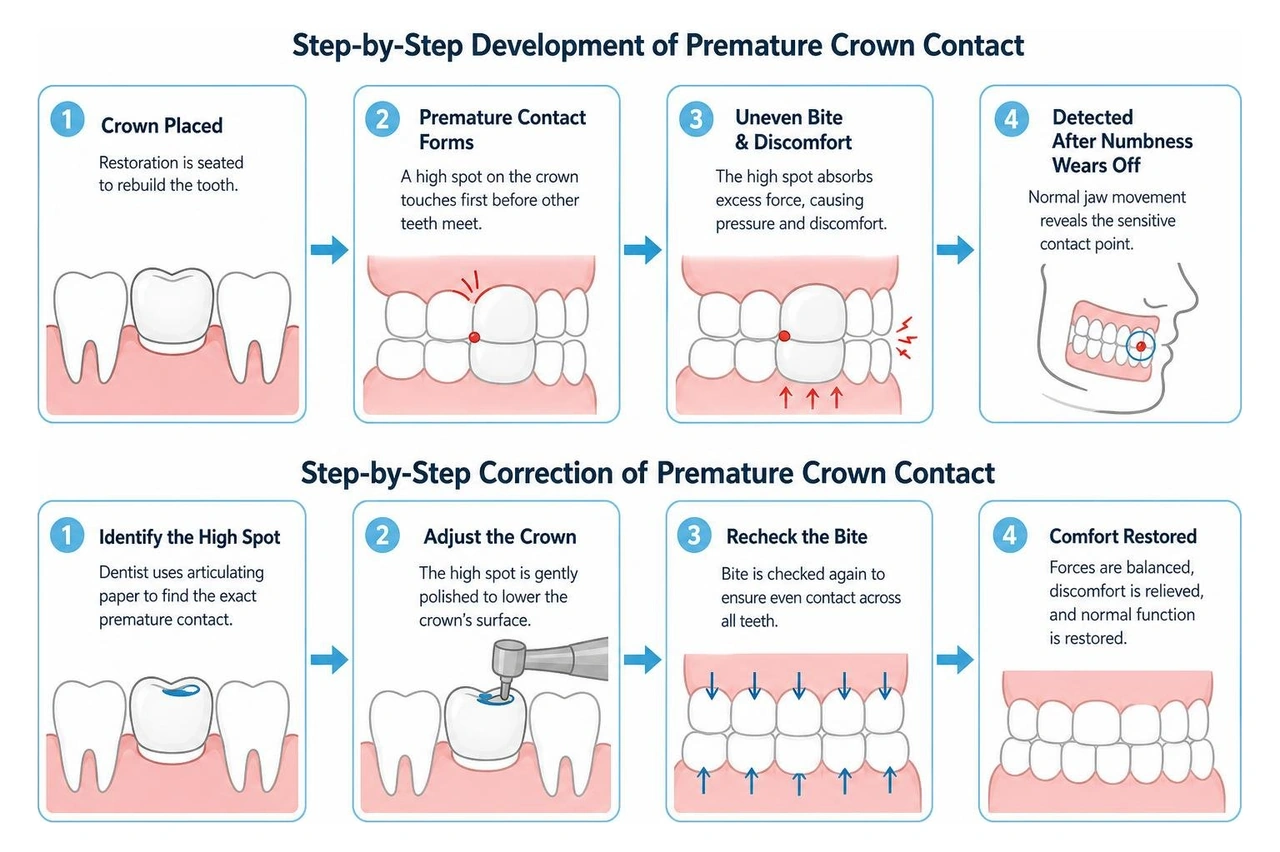
A high spot, or premature contact, happens when one specific area of your new crown makes contact with the opposing tooth before your other teeth come together. Several factors can cause this during treatment:
- Local anesthesia numbness: When your mouth is numb during the procedure, it is tricky to close your jaw in its natural resting position. You might bite down slightly differently while giving feedback.
- Microscopic variations: Even with precise impressions, microscopic discrepancies in dental cement thickness can lift a crown by a fraction of a millimeter.
- Tissue swelling: Mild swelling around the gumline after dental crown prep can temporarily alter how your teeth rest together.
- Dynamic jaw movement: Teeth do not just touch up and down. They slide side to side and forward when chewing and speaking, which can reveal subtle contact points once normal daily activities resume.
Is Needing a Bite Adjustment a Sign of Poor Dental Work?
Needing a minor tweak after getting a crown is completely normal and very common. It is not a sign of poor craftsmanship or a faulty crown. Because the human mouth can detect a tiny hair between teeth, your bite is sensitive to minute elevations.
Crafting the best crowns for teeth involves custom tailoring every curve to match your natural smile. Fine-tuning the biting surface after the numbness wears off is simply a standard, routine part of making sure your restoration functions comfortably in your everyday life.
Common Symptoms That Indicate an Uneven Bite
After receiving a crown, it usually takes a few days to a week for your bite to adjust to the new shape. However, if something feels physically wrong rather than just new, you might be dealing with an uneven bite. Common signs include:
- Feeling the crowned tooth hit first whenever your mouth closes
- Sharp or dull pain when biting down on firm food
- Unintentionally biting your cheek or tongue on the side with the new crown
- A sensation that the restoration feels bulky or too tall
- Heightened sensitivity to hot or cold drinks
Localized Pain and Chewing Sensitivity
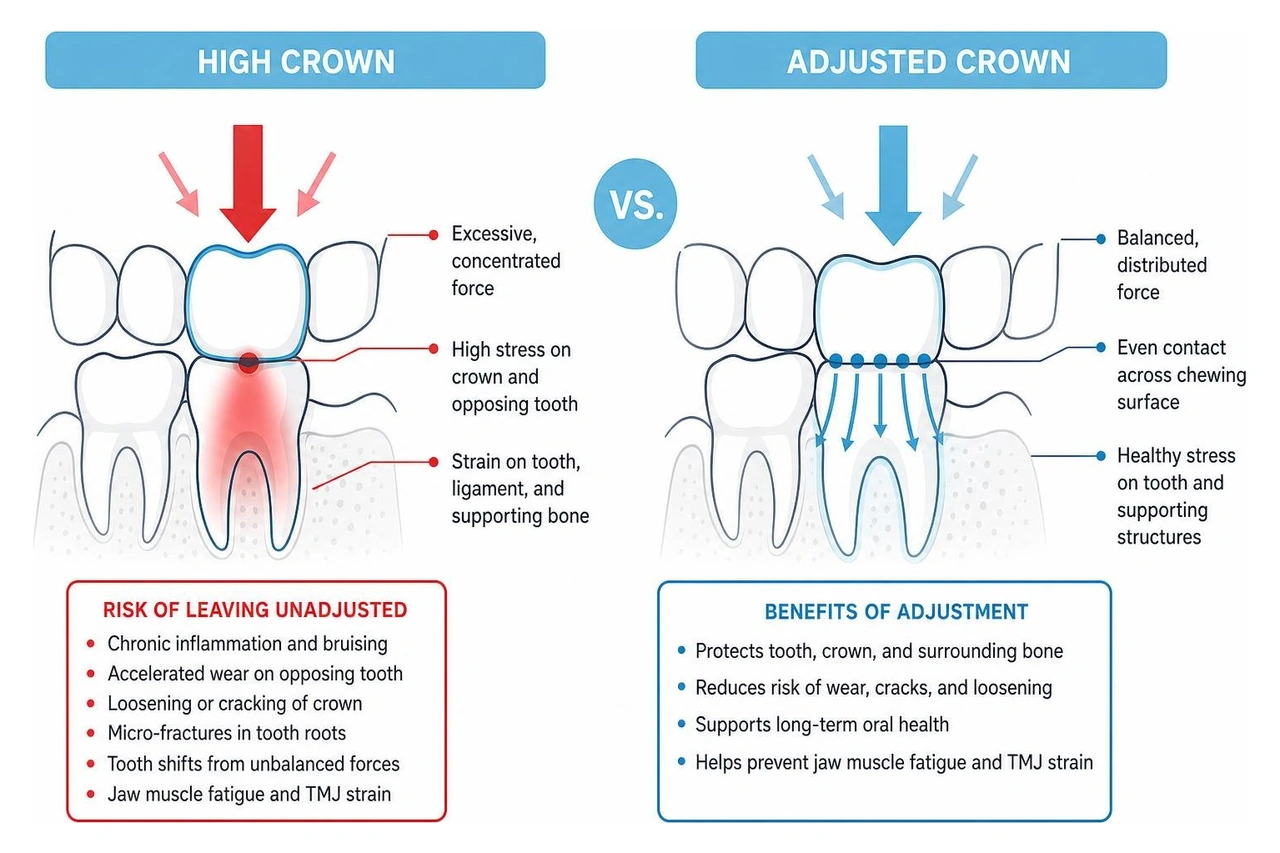
When a crown is too high, it absorbs excessive biting pressure. Underneath your tooth sits the periodontal ligament, a delicate hammock of tissue and nerve fibers that anchors the tooth root to the jawbone. When this ligament takes repeated, heavy pounding from an elevated crown, it becomes bruised and inflamed.
This inflammation creates localized pain that feels like a toothache whenever you chew. You might notice that the tooth feels fine at rest, but the moment you bite into something, a sudden ache shoots through the area.
Jaw Fatigue, Headaches, and TMJ Strain
An uneven crown does not just affect the single tooth; it can disrupt the entire muscular balance of your face and head. When your teeth do not fit together evenly, your jaw muscles work overtime trying to find a comfortable resting position.
If you find yourself wondering why does my jaw hurt after dental treatment, an unadjusted crown could be the culprit. Overworked masseter muscles can lead to tension headaches, facial soreness, and early symptoms of tmj problems. Over time, leaving the imbalance unchecked can cause popping, clicking, or pain in the jaw joint itself, requiring targeted care for tmj discomfort.
Risks of Leaving a High Crown Unadjusted
Hoping that a high crown will simply wear down on its own is a common mistake. Modern restorative materials like zirconia and porcelain are strong and durable, meaning they will not quickly wear away from regular chewing. Leaving a high crown unadjusted can lead to serious oral health complications:
- Chronic inflammation and bruising of the periodontal ligament
- Accelerated enamel wear on healthy opposing natural teeth
- Loosening or cracking of the dental crown itself
- Micro-fractures in the root of the crowned tooth or the opposing tooth
- Shifts in adjacent teeth as they drift away from unbalanced bite forces
- Long-term muscle spasms and temporomandibular joint dysfunction
Long-Term Damage to Opposing and Adjacent Teeth
When two teeth collide with uneven force, the natural tooth opposing the crown often suffers the most damage. The hard ceramic surface of a crown can wear down natural tooth enamel like sandpaper, leading to tooth thinning, chips, and heightened nerve sensitivity.
Furthermore, excessive pressure can cause the underlying bone to retreat slightly, widening the periodontal ligament space and causing the crowned tooth to feel loose. Maintaining balanced contact protects your natural teeth as well as any neighboring crowns and bridges.
Nighttime Clenching and Bruxism Complications
For individuals who grind teeth at night, a high crown is particularly hazardous. Nocturnal clenching delivers intense, sustained pressure that can quickly fracture a ceramic restoration or crack the underlying tooth structure.
If you struggle with sleep clenching, getting a timely bite adjustment combined with custom nightguards and mouthguards will shield your teeth from destructive night grinding forces and preserve your smile for years to come.
What to Expect During the In-Office Correction
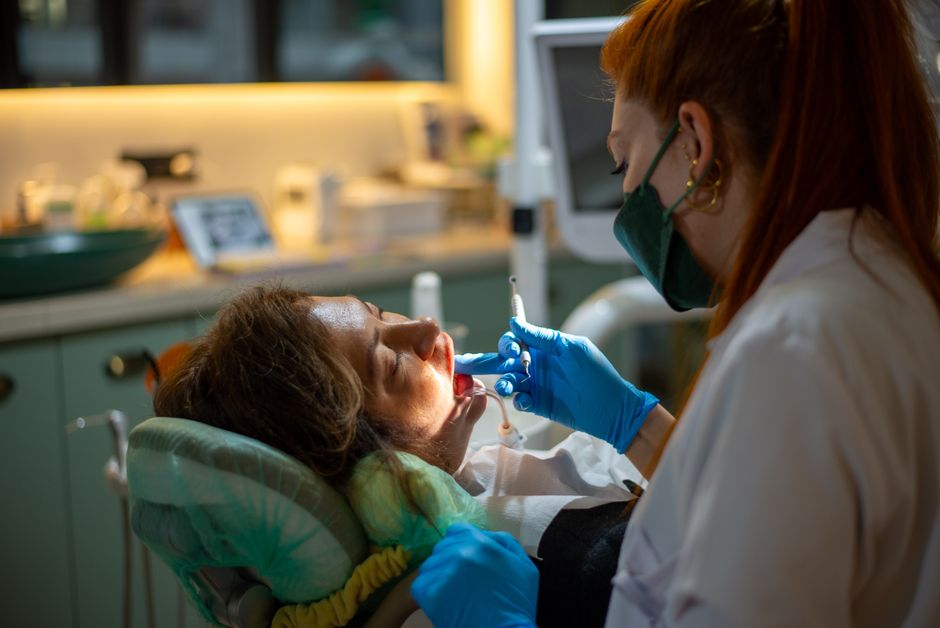
If your crown feels tall, you will be happy to know that a crown bite adjustment is a quick, straightforward, and painless procedure. Most visits for bite adjustment take less than 15 minutes and can be completed in a single visit without needing any local numbing shots.
For additional context on the diagnostic tools used during this appointment, you can read this clinical guide on articulating paper bite balancing.
Step-by-Step Crown Bite Adjustment Process at the Dental Office
When you visit our office for a bite check, we follow a simple, gentle process to restore bite harmony:
- Initial conversation: We listen to your symptoms, asking where the tooth feels high and whether you experience pain during chewing or when closing your mouth.
- Marking the bite: We place a thin strip of articulating paper between your teeth and ask you to tap your teeth together and slide your jaw side to side.
- Pinpointing high spots: The paper leaves small colored ink marks on the exact raised contact points causing the interference.
- Gentle smoothing: Using a fine, specialized diamond finishing bur, we gently buff away a fraction of a millimeter of material from the marked areas.
- Re-checking the contact: We place fresh paper between your teeth and check the bite again to confirm that contact marks are balanced evenly across all your teeth.
- Polishing: Once the height is balanced, we polish the smoothed area so your crown feels sleek and natural against your tongue.
How Dentists Identify Heavy Contact Points
Articulating paper acts like dental transfer paper, leaving dark colored marks where pressure is heaviest and lighter marks where contact is normal. A high spot often appears as a distinct mark or a "bullseye" pattern with a clear center, indicating that intense force is focused on that single peak.
By analyzing these marks during both static biting (tapping straight up and down) and dynamic chewing movements (grinding side to side), we can pinpoint where material needs to be smoothed without guessing.
Recovery, Aftercare, and Protecting Your Restoration
Once your bite is balanced, relief is often immediate, though any underlying ligament bruising may take a few days to completely calm down.
Caring for Your Tooth After a Crown Bite Adjustment
To help your tooth and gums heal quickly after an adjustment:
- Stick to a soft diet for 24 to 48 hours: Give your chewing muscles and periodontal ligament a short rest by enjoying softer foods like soups, eggs, pasta, and yogurt.
- Rinse with warm salt water: If your gums feel slightly tender near the base of the crown, rinse with warm salt water two to three times daily to reduce irritation.
- Brush and floss gently: Continue regular oral hygiene around your crown using a soft-bristled toothbrush and non-abrasive toothpaste.
- Avoid chewing ice or hard candies: Protect your crown by avoiding habits like chewing on pens, ice cubes, or hard candy.
Why You Should Never Attempt DIY Adjustments at Home
It might feel tempting to try filing down a rough or high spot at home using an emery board or nail file, but you should never attempt a DIY adjustment on a dental crown.
Household tools are non-sterile, can crack delicate ceramic layers, and will scratch the surface of the crown. Rough scratches create microscopic grooves where harmful plaque bacteria thrive, increasing the risk of gum disease and decay along the margin of the tooth. Only a dentist with precision dental instruments can safely smooth the material while preserving the strength of the crown.
Frequently Asked Questions About Crown Bite Adjustment
How long does it usually take for a new crown to feel normal?
It usually takes a few days to a week for your bite to adjust after getting a crown. During this time, your jaw muscles and tongue adapt to the new contour. However, if the tooth continues to hit first or causes soreness every time you bite down, do not wait for it to fix itself. Schedule a quick checkup with your dentist.
Does getting a crown bite adjustment hurt?
No, getting a bite adjustment does not hurt. The outer layer of a dental crown contains no living nerves, so gently buffing away microscopic high spots is completely painless and rarely requires local anesthesia. You will feel a light vibration from the polishing tool, and most visits take less than 15 minutes.
Can a bite adjustment be performed after permanent cementation?
Yes. Dentists routinely perform bite adjustments on permanently cemented crowns. Using fine diamond burs and specialized polishing paste, we can comfortably smooth and polish the outer ceramic or metal surface right in the chair without needing to remove or replace the crown.
Restoring Comfort to Your Smile
A dental crown should protect your tooth and let you eat, speak, and smile with complete confidence. If your new crown feels tall, causes soreness when you chew, or creates jaw tension, a quick adjustment can restore your bite balance and protect your long-term oral health.
At Champaign Dental Group, our family has been caring for smiles across Urbana, Mechanicsburg, Tremont City, West Liberty, and Springfield since 1997. Whether you need a bite check or are looking for a welcoming dental home for your whole family, we are here to help you feel at ease. If your bite feels uneven, please request an appointment today so we can get your smile back to feeling comfortable and natural.