.jpg)
The Great Debate: Veneers vs Crowns – Your Guide to a Brighter Smile
Understanding Your Smile Restoration Options
Crown vs veneer is one of the most common questions patients ask when considering cosmetic or restorative dental work. Both options can transform your smile, but they serve different purposes and work in distinct ways.
Quick Answer:
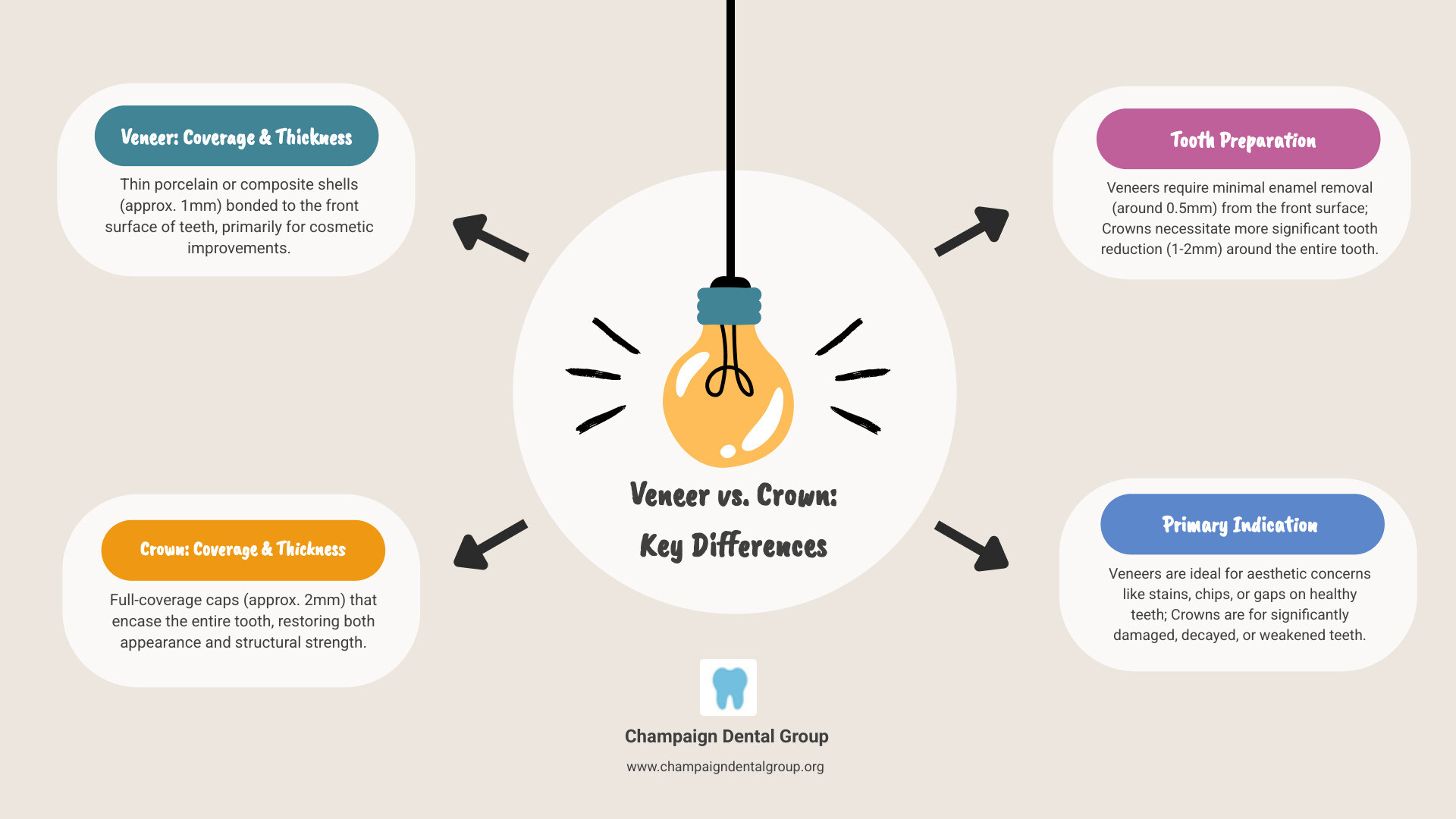
VeneersCrownsCover only the front surface of teethCover the entire tooth like a capAbout 1mm thickAbout 2mm thickRequire minimal enamel removal (0.5mm)Require more tooth reduction (1-2mm)Best for cosmetic improvementsBest for damaged or weakened teethPrimarily for front teethCan be used on any toothUsually not covered by insuranceOften partially covered when medically necessary
If you're a busy parent trying to figure out the best option for yourself or your family, you're not alone. The choice between veneers and crowns depends on several factors: the condition of your teeth, your aesthetic goals, and whether you need cosmetic improvement or structural support.
Veneers are thin porcelain or composite shells bonded to the front of your teeth. They're ideal for fixing minor cosmetic issues like stains, chips, or gaps. Think of them as a makeover for teeth that are mostly healthy but need a visual boost.
Crowns are full-coverage caps that encase your entire tooth. They're the go-to solution when a tooth is significantly damaged by decay, cracks, or large fillings—or after a root canal. Crowns restore both appearance and strength.
At Champaign Dental Group, our team understands that navigating these options while managing a busy family schedule can feel overwhelming. That's why we're committed to providing clear guidance and exceptional patient care to help you make the right choice. Our dentists take the time to explain your options and create a treatment plan that fits your needs and timeline.
Common Crown vs veneer vocab:
Understanding the Basics: What Are Veneers and Crowns?
When we talk about enhancing your smile or restoring a damaged tooth, two terms often come up: veneers and crowns. While both are excellent ways to improve your dental health and aesthetics, they serve different primary functions and involve different procedures. Let's dig into what each of these dental solutions entails.
What are Dental Veneers and How Do They Work?
Veneers are like custom-made, wafer-thin shells designed to cover the front surface of your teeth. They are primarily a cosmetic solution, aiming to improve the appearance of your smile by correcting issues such as discoloration, chips, minor alignment problems, or gaps between teeth. Imagine giving your teeth a beautiful, natural-looking facade!
The most common types of veneers are porcelain veneers and composite resin veneers. Porcelain veneers are renowned for their durability, stain resistance, and ability to mimic the natural translucency of tooth enamel, offering a highly aesthetic result. Composite resin veneers, while often more affordable, are applied directly to the tooth and typically don't last as long as their porcelain counterparts.
The process for getting veneers usually involves a few appointments. First, we'll consult with you to understand your aesthetic goals. Then, a small amount of enamel – typically about half a millimeter – is gently removed from the front surface of your teeth. This minimal preparation allows the veneer to bond securely without making your tooth appear bulky. An impression or digital scan is then taken, which our skilled dental lab uses to craft your custom veneers. Once fabricated, we carefully bond these thin laminates to your teeth, instantly changing your smile.
What are Dental Crowns and How Do They Work?
Dental crowns, often referred to as "caps," are a more comprehensive restorative solution. Unlike veneers, which only cover the front, a dental crown is a full-coverage cap that encases the entire visible portion of a damaged tooth, right down to the gum line. Think of it as a protective helmet for your tooth.
Crowns are primarily used to restore a tooth's form, function, and appearance when it's significantly compromised. This could be due to extensive decay, a large filling that has failed, a severe crack or fracture, or after a root canal procedure where the tooth becomes more brittle. They provide structural integrity, protecting the remaining tooth structure from further damage and restoring its ability to withstand chewing forces.
At Champaign Dental Group, we offer various types of crowns, including those made from porcelain, porcelain-fused-to-metal (PFM), or all-metal alloys. Porcelain crowns are favored for their natural appearance, especially for front teeth. PFM crowns offer a balance of strength and aesthetics, while all-metal crowns (like gold alloys) are incredibly durable and often used for back molars where biting forces are highest. The crown procedure involves reshaping the entire tooth, removing more enamel than for a veneer to create space for the cap. An impression is taken, and a temporary crown is placed while your permanent crown is custom-made. Once ready, the permanent crown is cemented over your prepared tooth, providing robust, long-lasting protection and a beautiful finish. You can learn more about our Crowns and Bridges services.
Crown vs veneer: Key Differences in Coverage and Preparation
The fundamental distinction between crown vs veneer lies in how much of your natural tooth they cover and the extent of tooth preparation required. These differences are crucial in determining which option is best suited for your specific dental needs.
FeatureVeneerCrownCoverage AreaFront surface onlyEntire tooth (all visible sides)ThicknessApproximately 0.3mm to 1mmApproximately 1mm to 2mmEnamel RemovalMinimal (about 0.5mm from front)More extensive (1-2mm from all sides)Primary PurposeCosmetic improvementRestorative and protectiveTooth PreservationMore conservativeLess conservative
Coverage and Thickness
A dental veneer is a thin shell that adheres to only the front surface of your tooth. It's like a new facade for your smile. Because it only covers the visible front, veneers are typically very thin, often around 0.3 to 1 millimeter thick. This minimal thickness is key to their aesthetic appeal and conservative nature.
In contrast, a dental crown is a full-coverage cap that completely encases the entire tooth, above the gum line. It covers the front, back, and sides, restoring the tooth's full anatomical shape. Due to this comprehensive coverage, crowns are generally thicker than veneers, typically ranging from 1 to 2 millimeters. This extra thickness provides the necessary strength and protection for a structurally compromised tooth.
Tooth Preparation Process
The tooth preparation process is perhaps the most significant difference when comparing crown vs veneer. For veneers, our goal is to be as conservative as possible. We typically remove only a very thin layer of enamel – about 0.5 millimeters – from the front surface of the tooth. This creates enough space for the veneer without making the tooth look bulky and ensures a strong bond. This conservative depth cutting technique is crucial for preserving as much of your natural tooth structure as possible. As highlighted in research on the success of dental veneers according to preparation design, a conservative approach is often beneficial for long-term success.
For crowns, the preparation is more extensive because the crown needs to fit over the entire tooth. We reshape the tooth, reducing it on all sides by 1 to 2 millimeters. This ensures that the crown can fully encompass the tooth without affecting your bite or appearing unnaturally large. While this means more tooth structure is removed compared to veneers, it's a necessary step to provide the tooth with the structural integrity and protection it needs, especially if it's severely damaged or weakened.
Understanding these differences in coverage and preparation helps us determine the most appropriate treatment plan for your unique dental situation.
Choosing the Right Option for Your Dental Needs
Deciding between a crown vs veneer isn't always straightforward, and it really comes down to what your teeth need and what you hope to achieve. Are you looking for a cosmetic touch-up, or does your tooth require significant structural support? At Champaign Dental Group, our compassionate team is here to help you steer these choices with confidence.
When a Crown vs veneer is Preferable for Restoration
When a tooth has significant damage or decay, a crown is almost always the preferred choice. Crowns are designed to restore strength and function, making them ideal in situations where a veneer simply wouldn't provide enough support.
Consider these scenarios where a crown typically shines:
- Minimal Tooth Structure: If a tooth has lost a substantial amount of its original structure due to a large cavity or fracture, a crown can effectively rebuild and protect it. It acts as a full-coverage shield, preventing further breakage.
- Large Fillings: Teeth with very large or failing fillings often benefit more from a crown. The crown can hold the remaining tooth together, preventing it from cracking or collapsing.
- Fractures and Cracks: A tooth with significant cracks or fractures that extend deep into the tooth structure needs the comprehensive support a crown offers. It binds the tooth together, preventing the crack from worsening.
- After a Root Canal: Teeth that have undergone a root canal procedure can become brittle. A crown is essential to protect these weakened teeth from fracturing, especially acrylic cap for teeth after the procedure.
- Biting Forces and Location: For back teeth (molars and bicuspids) that endure considerable biting forces, crowns provide superior durability and protection. While veneers are typically used for anterior (front) teeth, crowns can be used on any tooth, including those in the back of your mouth that bear the brunt of chewing.
- Dental Bridges or Implants: Crowns are also integral components of dental bridges, where they anchor the bridge to adjacent healthy teeth, or as the visible restoration placed on top of a dental implant.
In these cases, the primary purpose is restorative – to save the tooth, restore its function, and protect it for years to come. Our dentists in Urbana, OH and Champaign County, OH, are experts in recommending the Best Crowns for Teeth for your specific needs, ensuring both strength and natural aesthetics.
Cosmetic Considerations for a Crown vs veneer
While crowns offer restorative benefits, veneers are often the stars of purely cosmetic improvements. If your teeth are largely healthy but have aesthetic imperfections, veneers can provide a stunning smile makeover.
Here’s when veneers are usually the go-to for cosmetic improvements:
- Surface Stains and Discoloration: If your teeth are deeply stained and don't respond to professional whitening treatments, veneers can provide a uniformly bright and radiant smile.
- Chips and Minor Fractures: For small chips or minor surface fractures that don't compromise the tooth's structural integrity, veneers can seamlessly restore a smooth, flawless appearance.
- Gaps Between Teeth: Veneers can effectively close small gaps or spaces between teeth, creating a more harmonious smile without the need for orthodontics.
- Irregular Shape or Size: If you have teeth that are slightly misshapen, too small, or uneven in length, veneers can reshape and resize them for a perfectly symmetrical look.
- Minor Alignment Issues: For teeth with slight crookedness or minor alignment problems, veneers can create the appearance of straight teeth, often referred to as "instant orthodontics." If your alignment issues are more significant, we might discuss options like Teeth Bonding vs Veneers or even traditional orthodontics.
Aesthetic Differences: Natural Appearance and Gum Margins
When it comes to aesthetics, both crowns and veneers can be crafted to look incredibly natural. However, there are subtle differences, particularly regarding gum margins and overall appearance.
- Natural Appearance and Translucency: High-quality porcelain veneers and crowns are custom-made to match the color, shape, and translucency of your natural teeth. Our goal is always to create restorations that are indistinguishable from your surrounding teeth. Porcelain, in particular, mimics the way natural enamel reflects light, giving a very lifelike appearance.
- Gum Margins: This is where a key aesthetic difference can emerge. With crowns, especially porcelain-fused-to-metal (PFM) crowns, a thin dark line can sometimes become visible at the gum margin over time as gums recede slightly. All-porcelain crowns, however, eliminate this concern entirely, offering a seamless transition with the gum tissue. Veneers, by their nature, end just at or above the gum line and are less likely to show a noticeable margin, contributing to a consistently beautiful smile even as gums subtly change over the years.
- Shade Matching and Tint Selection: Achieving the perfect color match is paramount for both veneers and crowns. We work closely with experienced dental lab technicians who are masters at their craft. Their expertise, sometimes even involving their presence for direct shade and tint selection, ensures that your new restorations blend flawlessly with your existing teeth. This meticulous attention to detail is why our patients in Urbana and Champaign County, OH, trust us with their smile changes. You can learn more about the considerations for veneers, including aesthetic costs, in our Porcelain Veneer Cost Complete Guide.
The choice between a crown vs veneer is a personalized one, made in close consultation with our skilled dentists. We consider the health of your existing tooth structure, the extent of any decay or damage, and your desired aesthetic outcome to recommend the option that will best serve your long-term dental health and smile goals.
Longevity, Cost, and Insurance Considerations
When investing in your smile, understanding the expected lifespan, the financial commitment, and how dental insurance plays a role is essential for both crown vs veneer options.
Lifespan and Durability
Both dental veneers and crowns are designed for long-term durability, but their typical lifespans can vary depending on the material, the patient's oral hygiene, and lifestyle factors.
- Veneers: Porcelain veneers are quite resilient and can typically last between 10 to 15 years, sometimes even longer with excellent care. Composite veneers, while a good immediate solution, generally have a shorter lifespan, usually around 5 to 7 years. The longevity of veneers is influenced by avoiding habits like chewing on hard objects, nail-biting, or using teeth as tools.
- Crowns: Dental crowns, particularly those made from durable materials like porcelain or metal alloys, have an impressive average lifespan. Many crowns can last 10 to 15 years, and with diligent maintenance, some can even last for decades. Metal crowns are known for their exceptional longevity and resistance to wear and tear. Porcelain crowns offer a beautiful aesthetic alongside substantial durability.
Regardless of the choice, proper care is the most significant factor influencing how long your restorations will last. Think of it this way: your natural teeth last longer when you take good care of them, and the same principle applies to your veneers and crowns!
Cost and Insurance Coverage
Discussing the cost of dental procedures can be a sensitive topic, but we believe in transparency. While we cannot provide specific pricing information here (as costs vary based on material, complexity, and individual needs), we can discuss how the costs of crown vs veneer generally compare and the role of insurance.
- Cost Comparison: Generally, the overall cost per tooth for veneers and crowns can be quite similar, especially when considering high-quality porcelain options for both. However, there can be variations. For instance, composite veneers are typically less expensive than porcelain veneers, and certain types of crowns (like all-metal) might differ in cost from all-porcelain crowns. For more detailed information on composite options, you can refer to our Composite Veneers Complete Guide.
- Insurance Coverage: This is often a significant factor for our patients in Urbana and Champaign County, OH. The key difference here lies in whether the procedure is considered "cosmetic" or "restorative" by your insurance provider.
- Veneers: Because veneers are primarily chosen for aesthetic improvement, they are often considered elective cosmetic procedures. As such, dental insurance plans typically do not cover the cost of veneers.
- Crowns: Crowns, on the other hand, are frequently considered medically necessary restorative procedures. When a tooth is severely damaged by decay, fracture, or requires protection after a root canal, insurance providers are much more likely to cover a portion of the crown's cost. This partial coverage can make a significant difference in your out-of-pocket expenses. You can explore more about crown costs in your area through our Dental Crown Cost Ohio guide.
At Champaign Dental Group, we understand that financial considerations are part of your decision-making process. Our dedicated team is always available to discuss payment options and help you understand your insurance benefits. We also offer our Smile Protection Plan to make affordable dentistry more accessible for our patients without insurance, ensuring that high-quality patient care is within reach for everyone in our community.
Aftercare and Maintaining Your New Smile
Once you've made the decision between a crown vs veneer and started on your smile change journey, the next crucial step is ensuring the longevity and brilliance of your new restorations. Excellent aftercare and consistent oral hygiene are paramount, just as they are for your natural teeth.
Essential Oral Hygiene Practices
Whether you have veneers or crowns, maintaining a rigorous oral hygiene routine is non-negotiable. Our team at Champaign Dental Group emphasizes these practices for all our patients:
- Brushing: Brush your teeth at least twice a day, preferably after every meal. Use a soft-bristled toothbrush and a non-abrasive fluoride toothpaste. Pay special attention to the gum line, where the porcelain meets your natural tooth. This area is particularly vulnerable to plaque buildup, which can lead to tooth decay if not cleaned properly.
- Flossing: Floss daily to remove food particles and plaque from between your teeth and under the gum line. This prevents gum disease and decay around your restorations.
- Mouthwash: Consider using an antibacterial mouthwash recommended by your dentist to further reduce bacteria and maintain fresh breath.
Protecting Your Investment
Beyond daily cleaning, there are a few extra steps you can take to protect your veneers and crowns:
- Avoid Hard and Sticky Foods: While both restorations are durable, extreme forces can cause chipping or fracturing. Be cautious with very hard foods (like hard candy, ice, or nuts) and extremely sticky foods.
- Night Guards: If you have a habit of grinding or clenching your teeth (bruxism) at night, we highly recommend wearing a custom-fitted night guard. This simple device can significantly protect your veneers and crowns from excessive pressure and wear.
- Regular Dental Check-ups: Consistent visits to Champaign Dental Group for professional cleanings and check-ups are vital. Our dentists can monitor the condition of your restorations, check for any signs of wear or damage, and address any potential issues early on. These regular appointments are a cornerstone of our comprehensive Restorative Dentistry Services Guide and ensure your smile remains healthy and beautiful for years to come.
By following these aftercare guidelines, you're not just maintaining your veneers or crowns; you're investing in your overall oral health and ensuring that your radiant smile continues to shine brightly.
Frequently Asked Questions about Veneers and Crowns
We often hear similar questions from our patients in Urbana and Champaign County, OH, when they are considering crown vs veneer. Let's address some of the most common ones to help you feel more informed and confident in your decision.
Are veneers reversible?
This is a crucial question, and the straightforward answer is generally no. Because the veneer process involves removing a small amount of your natural tooth enamel – typically about 0.5 millimeters – the procedure is considered irreversible. Once that enamel is removed, your tooth will always need to be covered by a veneer or another type of restoration.
This means that choosing veneers is a long-term commitment. It's why we take such care at Champaign Dental Group to ensure you're fully informed and comfortable with your decision before proceeding. For more details on this topic, you can read our article, "Are Veneers Reversible?". The goal is to improve your natural beauty, and we want you to love your new smile for a lifetime!
Can I whiten my veneers or crowns?
This is another excellent question, and the answer is no, not with traditional teeth whitening products. The materials used for veneers (porcelain or composite) and crowns (porcelain, metal, PFM) are highly stain-resistant, which is a fantastic benefit for maintaining a bright smile! However, this also means they do not respond to the bleaching agents used in teeth whitening gels or strips.
The color of your veneers or crowns is chosen and finalized during their fabrication process. Once they are bonded to your teeth, their shade will remain consistent. This highlights the importance of discussing your desired shade with your dentist before placement. If you are considering whitening your natural teeth, it's often recommended to do so before getting veneers or crowns so that your new restorations can be matched to your whitened natural teeth for a seamless result.
Which lasts longer, a crown or a veneer?
The longevity of both crowns and veneers is impressive, but generally, crowns tend to have a slightly longer average lifespan than veneers.
- Veneers: Porcelain veneers typically last about 10 to 15 years. Composite veneers, while more cost-effective upfront, may need replacement in about 5 to 7 years. The thinner nature of veneers can make them more susceptible to chipping or breaking under extreme pressure.
- Crowns: Dental crowns, particularly those made from durable materials, often last 10 to 15 years, and it's not uncommon for them to last 20 years or more with diligent care. Their full-coverage design provides greater structural protection and can withstand more significant biting forces.
The key takeaway is that both restorations require commitment to excellent oral hygiene and regular dental check-ups to maximize their lifespan. Factors like grinding your teeth, chewing on hard objects, or neglecting daily brushing and flossing can shorten the life of either restoration. Our team will guide you on the best maintenance practices to ensure your investment in your smile lasts as long as possible.
Conclusion
Navigating the choice between a crown vs veneer can feel like a big decision, but it's one you don't have to make alone. Both offer incredible benefits for enhancing your smile, whether you're seeking purely cosmetic improvements or require significant structural restoration for a damaged tooth.
At Champaign Dental Group, we are dedicated to providing the highest quality patient care with a compassionate approach. Our experienced dentists in Urbana and Champaign County, OH, use state-of-the-art technology to ensure precise diagnoses and optimal treatment outcomes. We take the time to listen to your concerns, understand your aesthetic goals, and carefully assess your dental health to recommend the personalized treatment plan that is right for you and your family.
Whether you're looking to brighten your smile with veneers or restore the strength and function of a damaged tooth with a crown, we are here to guide you every step of the way. Our goal is to empower you with information and deliver exceptional dental care that leaves you with a healthy, confident, and radiant smile.
Ready to explore your options and find which solution is best for your unique needs? We invite you to schedule a consultation with our friendly team. Let us help you achieve the smile you've always dreamed of!
For more detailed information about our comprehensive services, including crown and bridge services, please visit our website or contact us directly. We look forward to welcoming you to the Champaign Dental Group family!