.jpg)
The Tooth the Whole Tooth and Nothing But the Tooth About Kids' Checkups
_compressed.jpeg)
Why a Dental Checkup for Kids Sets the Stage for a Lifetime of Healthy Smiles
A dental checkup for kids is one of the most important — and most overlooked — steps in your child's overall health routine. Here's what every parent needs to know at a glance:
Quick answers:
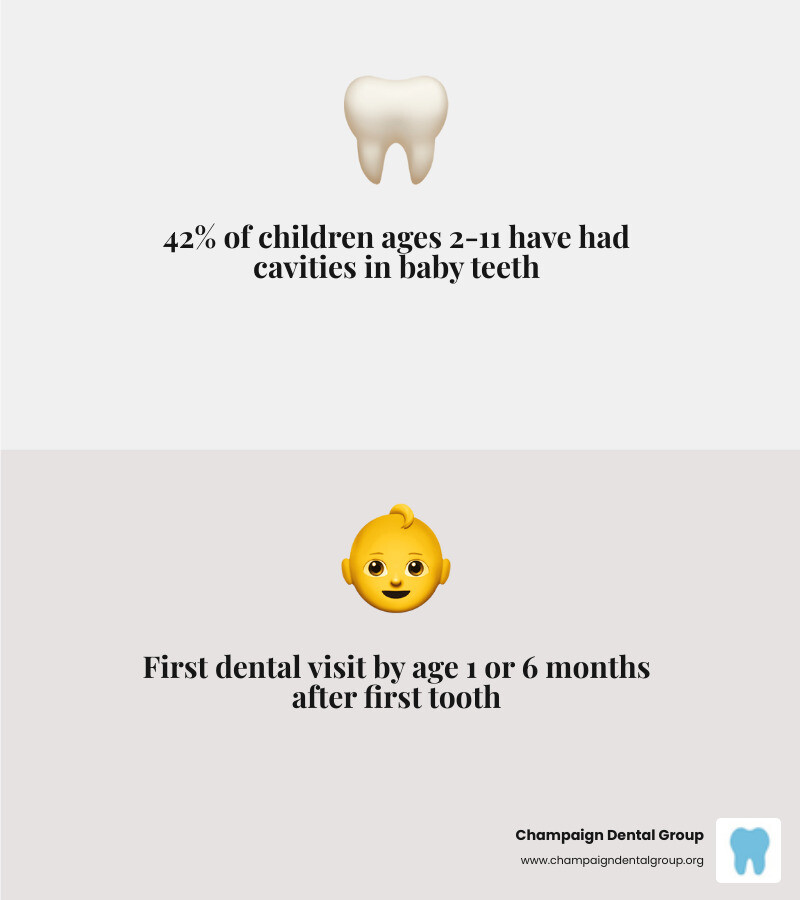
- First visit: Within 6 months of the first tooth erupting, or by age 1 — whichever comes first
- How often: Every 6 months (sometimes every 3 months for higher-risk kids)
- What happens: Exam of teeth, gums, bite, and jaw; gentle cleaning; fluoride advice; X-rays only if needed
- Who to see: A general dentist or pediatric dentist — both are trained to care for young children
- Home care: Brush twice daily with fluoride toothpaste, floss when teeth touch, limit sugary drinks
Did you know that 42% of children between ages 2 and 11 have already had cavities in their baby teeth? That's not a small number. And many of those cavities could have been caught — or prevented entirely — with regular checkups.
Baby teeth aren't just placeholders. They guide speech development, hold space for permanent teeth, and set the tone for lifelong oral health. Skipping early dental visits means missing a real window for prevention.
The good news? Getting started is simple, and the team at Champaign Dental Group is here to make every visit comfortable, clear, and stress-free for both you and your child.
Dental checkup for kids terms to know:
When to Schedule the First Dental Checkup for Kids
One of the most common questions we hear in our Urbana office is: "When does my baby actually need to see a dentist?" It’s a fair question! After all, if they only have two tiny teeth, what is there to check?
As it turns out, quite a bit. The Canadian Dental Association recommendations and the American Academy of Pediatric Dentistry both agree: your child should have their first assessment within six months of their first tooth appearing, or by their first birthday at the latest.
Think of this first visit as a "well-baby" checkup for the mouth. We aren't just looking at the teeth; we are looking at the gums, the jaw, and how everything is developing. It’s also the perfect time for us to chat with you about family dentistry and how to protect those brand-new "pearly whites" from the start.
Starting early has a hidden benefit, too: it prevents "white coat syndrome." When a child starts coming to see us before they have any dental pain, they learn that the dentist's office is a friendly, safe place. They get to ride in the "magic chair," meet our high-quality patient care team, and maybe even leave with a cool new toothbrush. This builds a foundation of trust that lasts into adulthood.
What Happens During a Pediatric Dental Exam
If you’re nervous about how your child will react to a dental checkup for kids, don't worry—we’ve seen it all! From the "I’m-not-opening-my-mouth" toddler to the "I-want-to-touch-everything" preschooler, our staff is trained to handle every personality with patience and a smile.
A typical comprehensive dental examination for a child is much quicker and gentler than an adult's. Here is what you can expect:
- The Visual Inspection: We’ll use a small, round mirror to look at every tooth. We check for any signs of decay (which can look like chalky white or brown spots) and ensure the teeth are erupting in the right order.
- The Cleaning: If your child is ready, a dental hygienist will perform a gentle cleaning. This involves removing any plaque or tartar that has built up. We use specialized, smaller tools designed for tiny mouths to make the process as comfortable as possible.
- The "Big Picture" Check: We don't just look at teeth. We examine:
- Bite Alignment: Is the upper jaw meeting the lower jaw correctly?
- Gum Health: Are the gums pink and firm, or is there inflammation?
- Oral Tissues: We check the tongue, cheeks, and floor of the mouth for any unusual bumps or sores.
- Jaw Development: We monitor how the jawbone is growing to accommodate future permanent teeth.
The Role of Fluoride and Sealants in a Dental Checkup for Kids
Prevention is the heart of paediatric and preventive dentistry. During the checkup, we often discuss two "superheroes" of tooth protection: fluoride and sealants.
- Fluoride: This is a naturally occurring mineral that acts like armor for tooth enamel. It makes the teeth more resistant to the acid produced by bacteria. Depending on your child’s risk for cavities, we may apply a fluoride varnish during their visit. It only takes a minute and tastes like bubblegum or grape!
- Dental Sealants: Once your child’s permanent molars come in (usually around age 6 and again at age 12), we may recommend sealants. These are thin, plastic coatings painted onto the chewing surfaces of the back teeth. Molars have deep "valleys" where food and bacteria love to hide; sealants smooth these out, making the teeth much easier to brush and significantly reducing the risk of decay.
Are Dental X-Rays Necessary for Young Children?
We understand that many parents have concerns about radiation. Rest assured, at Champaign Dental Group, we only recommend dental X-rays for kids when absolutely necessary.
For very young children, we rarely need X-rays unless we suspect a "hidden" cavity between teeth or want to check on the progress of permanent teeth that haven't erupted yet. When we do take them, we use digital X-rays (which use much less radiation than traditional film) and protective lead aprons to ensure the highest level of safety.
X-rays are vital for catching problems that the naked eye can’t see, such as impacted teeth or bone issues. If your child has a high risk of decay or has experienced dental trauma, X-rays help us intervene before a small problem becomes a major one.
Preparing Your Child for a Positive Experience
Preparation is the key to a tear-free dental checkup for kids. Children are often afraid of the unknown, so the more you can normalize the visit, the better.
- Timing is Everything: Schedule appointments for the morning when your child is well-rested and less likely to be "cranky." A tired toddler and a dental chair are rarely a good mix!
- Keep it Simple: Use non-scary words. Instead of saying "The dentist is going to check for cavities with a sharp tool," try "The dentist is going to count your teeth and take pictures of your smile with a tiny mirror."
- Play Dentist at Home: Grab a toothbrush and a flashlight and "examine" your child's stuffed animals. Then let your child "examine" your teeth!
- Stay Positive: Children are like little sponges—they soak up your emotions. If you are nervous about the dentist, try not to show it. Focus on the fun parts, like the "magic chair" and the prize at the end.
For more details on what to expect, check out our guide on what to expect at your first visit.
General vs. Pediatric Dentists: Which is Right for Your Child?
Many parents wonder if they should take their child to a specialist or if their family dentist is sufficient. Here is a quick comparison:
FeatureGeneral DentistPediatric DentistTrainingTrained to treat patients of all ages, from infants to seniors.2–3 years of additional specialized training in child development and behavior.EnvironmentUsually a professional, family-friendly office.Often decorated specifically for kids (arcades, bright colors).ScopeCan handle routine cleanings, fillings, and preventive care for the whole family.Specialized in complex cases, developmental delays, or severe dental anxiety.ConvenienceChampaign Dental Group offers "block scheduling" so the whole family can be seen at once!May require a separate trip to a different office.
At Champaign Dental Group, we pride ourselves on providing high-quality patient care that bridges the gap. Our team is exceptionally skilled at making children feel at home while offering the convenience of a full-service family practice.
Understanding Age-Appropriate Behaviors During a Dental Checkup for Kids
It helps to know what is "normal" for your child’s age group so you don't feel embarrassed if they aren't a perfect angel in the chair.
- 10–24 Months: Separation anxiety is huge here. It is very common for babies to cry when a "stranger" looks in their mouth. We often perform "knee-to-knee" exams where the child stays in your lap.
- 2–3 Years: This is the "No" phase. Independence is growing, but so is fear of the unknown. We keep these visits very fast and focused on play.
- 4+ Years: Most children are ready to sit in the big chair by themselves and can follow simple instructions.
If you are looking for children dentists near Urbana Ohio, our team is well-versed in these developmental milestones and will never judge a fussy toddler!
Protecting Little Smiles: Home Care and Prevention
The work we do during a dental checkup for kids is only half the battle. The other half happens at your bathroom sink in Urbana or Champaign County!
- The "Rice" Rule: For children under age 3, use a tiny smear of fluoride toothpaste (about the size of a grain of rice).
- The "Pea" Rule: Once they turn 3, you can move up to a pea-sized amount. Encourage them to spit it out rather than swallow it.
- Flossing: As soon as two teeth touch, it’s time to floss! Bacteria love the tight spaces between teeth that a toothbrush can’t reach.
- Supervision: Most kids don't have the manual dexterity to brush effectively on their own until they can tie their own shoes (around age 7 or 8). Until then, they need your help to reach the back molars.
Another surprising factor in oral health is your environment. Research from smokefree.gov suggests that children exposed to secondhand smoke are actually more likely to develop cavities. Keeping your home and car smoke-free is a great way to protect their lungs and their teeth.
Preventing Baby Bottle Tooth Decay and Cavities
"Baby bottle tooth decay" happens when a child’s teeth are frequently exposed to sugary liquids (like milk, formula, or fruit juice) for long periods. This most often happens when a baby is put to bed with a bottle.
To prevent this:
- Finish the Bottle Before Bed: Don't let your baby drift off with a bottle in their mouth.
- Water is Best: If they need a "comfort" bottle at night, fill it only with water.
- The Cup Transition: Aim to transition your child from a bottle to a regular cup by their first birthday.
- Limit Juice: The AAP recommends no juice for infants under one year and very limited amounts for toddlers. Whole fruit is always a better choice!
We know that staying on top of dental health can feel like a big investment. That’s why we offer the Smile Protection Plan. This plan ensures that affordable dental care is accessible to every family in our community, covering preventive services and offering discounts on other treatments without the headaches of traditional insurance.
Frequently Asked Questions about Kids' Dental Visits
How often should children go for dental checkups?
For most children, we recommend a dental checkup for kids every six months. This allows us to catch cavities while they are tiny and monitor the development of the jaw and permanent teeth. Some children at higher risk for decay may benefit from visits every three months until their oral health stabilizes.
Why bother with fillings in baby teeth?
We hear this one a lot! "They're just going to fall out anyway, right?" While it’s true they are temporary, baby teeth are essential for several reasons. They allow your child to chew properly and speak clearly. Most importantly, they act as "space maintainers." If a baby tooth is lost too early due to decay, the surrounding teeth can shift into the gap, blocking the permanent tooth from coming in correctly. An untreated cavity can also lead to a painful infection or abscess that can damage the permanent tooth developing underneath.
How do I choose the right dentist for your child?
Look for a team that prioritizes high-quality patient care and makes you feel heard. You want a dentist who is patient, uses age-appropriate language, and has a clean, welcoming office. At Champaign Dental Group, we’ve been serving the Urbana and Champaign County area since 1997, and our USP is our compassionate care and deep community involvement. We treat your kids like our own!
Conclusion
A dental checkup for kids is about more than just avoiding cavities—it’s about giving your child the tools and the confidence to care for their health for the rest of their lives. From that very first tooth to the arrival of those permanent molars, the team at Champaign Dental Group is dedicated to providing compassionate, state-of-the-art care in a warm and friendly environment.
We are proud to be a part of the Urbana and Champaign County community, and we are committed to making sure every child in our area has a reason to smile. Whether you’re interested in our Smile Protection Plan or you just need to schedule a routine cleaning, we are here to help.
Ready to set your child on the path to a healthy smile? Request an appointment with us today or give us a call. We can't wait to meet you and your little one!