.jpg)
Implant Coverage Unveiled: What Your Dental Insurance Pays For

Why Understanding Implant Insurance Coverage Matters for Your Family
Does insurance pay for dental implants? The short answer is: it depends. Many dental insurance plans offer some coverage for dental implants, but most do not cover the full cost. Coverage typically ranges from 0% to 50% of the procedure and is subject to annual maximums, deductibles, and waiting periods.
Quick Coverage Overview:
- Typical Coverage: 0-50% of implant costs (if covered at all)
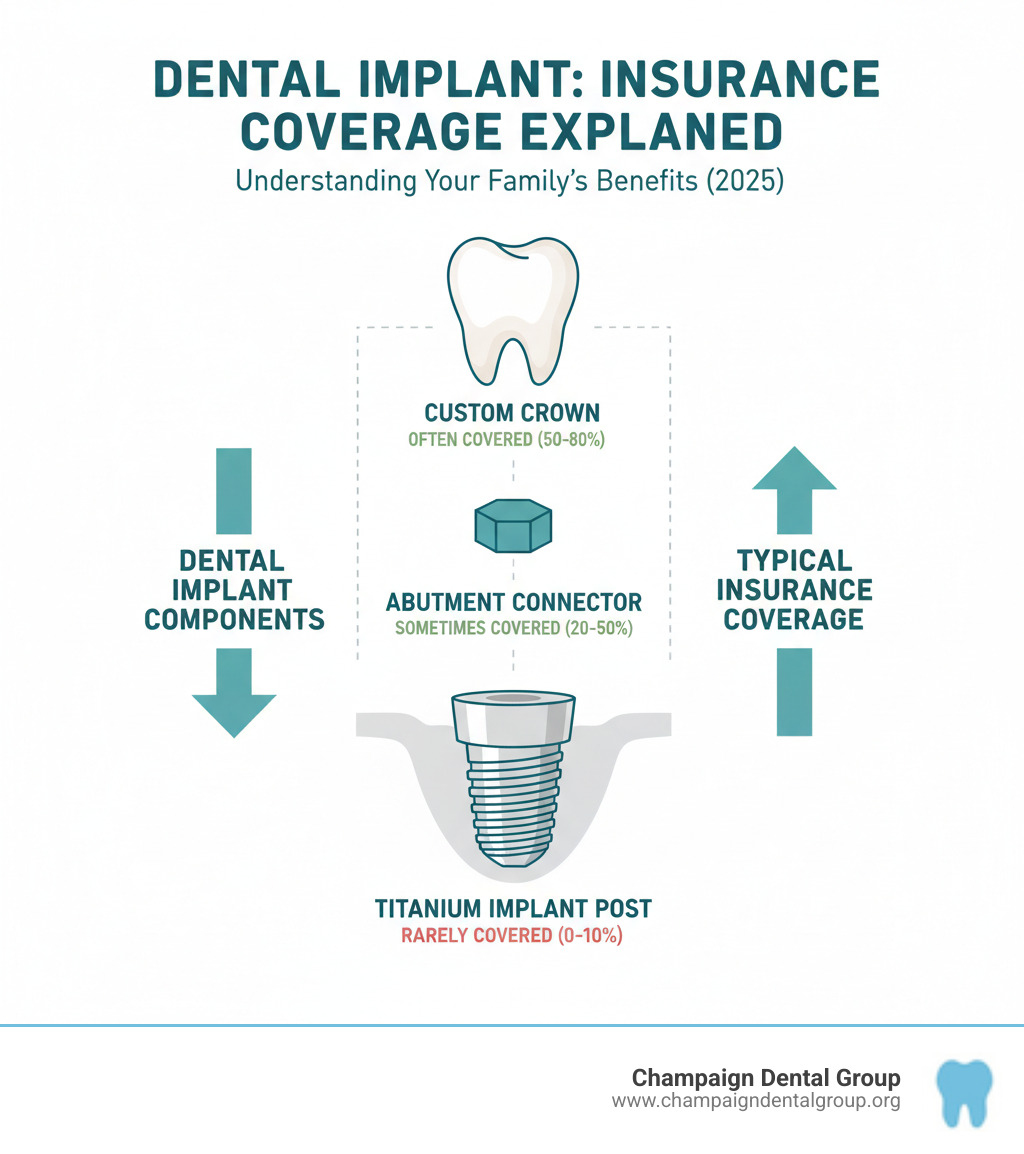
- What's Often Covered: The crown portion, sometimes the abutment
- What's Rarely Covered: The surgical implant post itself
- Average Out-of-Pocket: $2,800 to $5,600 per tooth
- Key Factors: Your specific plan, annual maximums, medical necessity
Dental implants offer a permanent solution for missing teeth that look and function naturally, but the cost can feel overwhelming for a family budget. The good news is that with the right planning, implants can be more accessible than you think. Understanding your insurance coverage is the first step.
At Champaign Dental Group, our compassionate team helps families steer insurance complexities every day. We believe everyone deserves access to high-quality dental care, so we take the time to explain your options and help you maximize your benefits. Our staff works with providers to secure pre-treatment estimates and offers flexible payment solutions, like our Smile Protection Plan, for services insurance doesn't cover.
This guide breaks down how dental insurance works for implants, what affects your coverage, and how you can minimize out-of-pocket costs.
Understanding Dental Insurance for Implants
Dental insurance policies can be confusing, especially for major procedures like implants. Most plans categorize procedures into tiers: preventive care (cleanings) is often covered at 80-100%, basic procedures (fillings) at 50-80%, and major work (crowns, implants) at 0-50%.
Before your insurance pays, you must meet your deductible. After that, payments are limited by the annual maximum, a cap on what your plan will pay per year. For a comprehensive procedure like an implant, you could hit this limit quickly. Many plans also have waiting periods of six months to a year for major procedures.
At Champaign Dental Group, we operate on a fee-for-service model, meaning we are not restricted by insurance company limitations. You are reimbursed directly by your insurer, and our knowledgeable staff works hard to help you understand and maximize your plan's benefits. We are committed to providing the highest quality of patient care, uncompromised by insurance networks.
For more context, see our guide on restorative dentistry services.
How to know if your dental insurance pays for dental implants
The best way to determine if your dental insurance pays for dental implants is to review your policy documents. Look for sections on "major restorative services" or "prosthodontics." Be aware that "full coverage" rarely means 100% coverage for everything. Also, check the "exclusions and limitations" section, where implants are sometimes listed.
Pay attention to CDT codes (Current Dental Terminology), which describe specific procedures. Implants involve multiple codes for the post, abutment, and crown, and some plans may cover certain components but not others. The caring team at Champaign Dental Group can help you understand what each code means for your coverage.
Your most reliable source is your insurance company. Call and ask specific questions about implant coverage, waiting periods, your annual maximum, and your deductible. Finally, ask our team for a pre-treatment estimate. We submit a detailed treatment plan to your insurer, who responds with an estimate of what they will pay. This provides a clear financial picture before you commit to treatment, reflecting our commitment to helping you make confident decisions.
Are some insurance plans better for implants?
Yes, some plans are more generous toward dental implants. If you're shopping for insurance, these differences can significantly impact your out-of-pocket costs.
- PPO plans (Preferred Provider Organizations) offer the most flexibility, allowing you to see any dentist, though they have higher premiums.
- DHMO plans (Dental Health Maintenance Organizations) have lower premiums but a restricted network of dentists and may offer more limited coverage for major procedures.
- Plans with high annual maximums ($2,000 or more) provide better support for implant procedures than those capped at $1,000.
- Plans without waiting periods for major services allow you to access implant coverage immediately.
Some specialized implant coverage options exist as riders or stand-alone policies, but they are less common. At Champaign Dental Group, our experienced staff will review your specific plan with you to help you get the most value from your benefits. Our high quality of patient care extends to your family's financial well-being. Learn more in our article on Dental Implants and Insurance.
What Determines the Cost and Coverage of Your Implants?
Understanding what drives the cost of dental implants helps you anticipate what insurance might cover. The cost to replace a single tooth with an implant typically ranges from $2,800 to $5,600. This variation is influenced by several key factors.
- Case Complexity: A straightforward single-tooth replacement costs less than replacing multiple teeth or managing complications.
- Preparatory Procedures: Treatments like bone grafting (to increase jawbone density) or a sinus lift are sometimes needed and add to the overall cost but are vital for long-term success.
- Dentist's Expertise & Technology: At Champaign Dental Group, we use advanced tools like Yomi® robotic dentistry for precise implant placement, leading to better outcomes and faster healing. Our team's skill ensures the procedure is done right the first time.
- Geographic Location: Dental costs vary by region. We are committed to providing exceptional care at fair prices for our community in Urbana and Champaign County.
- Materials and Restoration Type: The material used for the crown affects the final cost and aesthetics.
Different Types of Dental Implants and How They Affect Coverage
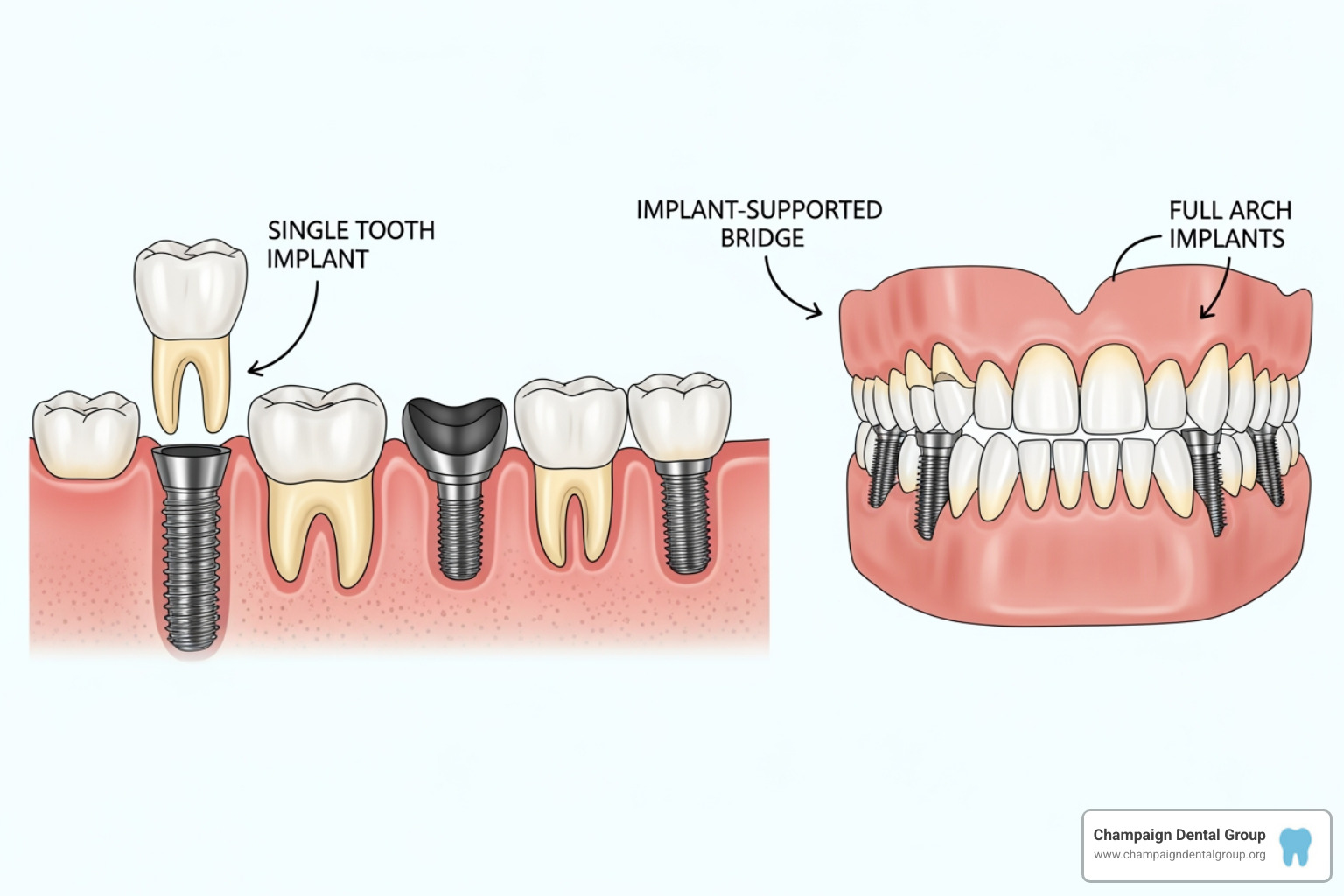
The type of implant you need influences how your insurance claim is processed. The most common is the endosteal implant, a titanium screw placed into the jawbone. Because they are widely used, insurers are more likely to have coverage policies for them.
For more complex cases, treatment scope plays a huge role. An implant-supported bridge replaces several teeth in a row using two or more implants, preserving adjacent healthy teeth. For patients missing most or all teeth, full mouth restorations like All-on-X use four to six implants to support a full arch of teeth. Due to the comprehensive nature of these treatments, insurance coverage can be complex, often covering a portion of the prosthetic but not the implant posts.
The compassionate team at Champaign Dental Group specializes in explaining these options and what your insurance might cover. For a complete overview, see our guide: Dental Implant Options: Your Guide for Replacing Missing Teeth.
[TABLE] comparing Dental Implants vs. Bridges vs. Dentures
While dental implants have a higher initial cost, their long-term value is often superior. This table compares your options.
| Feature | Dental Implants | Dental Bridges | Dentures (Full or Partial) |
|---|---|---|---|
| Upfront Cost | Higher | Moderate | Lower |
| Lifetime Cost | Potentially lower (long-lasting, minimal maintenance) | Moderate (replacement needed every 5-15 years) | Higher (frequent adjustments, repairs, and replacements) |
| Longevity | 20+ years, often a lifetime with proper care | 5-15 years | 5-10 years |
| Bone Health Impact | Preserves jawbone and stimulates healthy bone growth | No bone stimulation, leading to gradual bone loss | Accelerates jawbone deterioration |
| Maintenance | Brush and floss like your natural teeth | Requires special cleaning techniques under the bridge | Daily removal for cleaning, adhesives often needed |
| Aesthetics | Most natural look and feel | Natural-looking but requires modifying adjacent teeth | Can look natural but may slip or feel bulky |
| Functionality | Restores nearly 100% of your chewing power | Good chewing ability but less stable than implants | Limited chewing ability, some foods off-limits |
| Adjacent Teeth | Preserves surrounding healthy teeth | Requires grinding down healthy neighboring teeth | May put strain on remaining natural teeth |
Implants allow you to eat, laugh, and live without worry. The superior quality of care you receive at Champaign Dental Group means we help you look beyond the initial price to make a choice you'll feel good about for decades. For a more detailed comparison, read our article: Bridge vs Implant.
So, Does Insurance Pay for Dental Implants if They're Medically Necessary?
The term "medically necessary" can be a game-changer for implant coverage. In the eyes of insurance companies, dental necessity (e.g., replacing a tooth to improve chewing) is different from medical necessity (addressing a broader health condition).
If your tooth loss is due to decay or gum disease, it's typically handled by dental insurance with its usual limitations. However, if the loss resulted from an accident, a congenital condition, or a serious illness, you may have a case for medical necessity. This could shift coverage to your medical insurance, your dental insurance, or both.
Proving medical necessity requires solid documentation, including X-rays, your medical history, and a detailed letter from your dentist explaining why the implant is essential for your overall health. At Champaign Dental Group, our compassionate team understands this process can be overwhelming. We provide high-quality patient care by working with you to gather all necessary documents and support you through the appeals process if a claim is denied. As the AAOMS notes, coverage increasingly depends on this careful evaluation.
When does medical insurance pay for dental implants?
While dental insurance is the first place to look, your medical insurance may help in specific situations where tooth loss is not from routine dental issues.
- Accidents or Traumatic Injuries: If teeth are lost in a fall or car accident, medical insurance may view implants as reconstructive surgery. Thorough documentation of the incident is key.
- Congenital Defects: For conditions like ectodermal dysplasia or anodontia, where teeth never develop, implants are considered reconstructive care to address a birth condition.
- Tooth Loss from a Medical Condition: If oral cancer, chemotherapy, or radiation destroys teeth, replacing them is part of your medical recovery, not routine dental work.
- Medical Complications from Missing Teeth: If an inability to chew causes nutritional deficiencies or digestive problems, implants may be deemed medically necessary to resolve these broader health issues.
Our experienced team at Champaign Dental Group knows how to present these cases to medical insurers. We act as your advocates to maximize every possible avenue for coverage. Learn more about whether implants are right for you: The Advantages of Dental Implants: Is It Right For You?.
What about Medicare and Medicaid?
For those covered by Medicare or Medicaid, the question of does insurance pay for dental implants is more complex, as these programs offer very limited dental benefits.
Original Medicare (Parts A and B) generally excludes routine dental care, including implants. This is a common and disappointing gap in coverage for many seniors.
Medicare Advantage plans (Part C), offered by private companies, often include extra benefits. Some plans offer partial coverage for dental implants, but benefits vary dramatically. It's essential to research the specific plans available in the Urbana, OH, and Champaign County, OH, area.
Medicaid rules are state-specific. While children's dental care is comprehensive, adult benefits are often minimal. In Ohio, as in most states, Medicaid focuses on emergency and basic services, with very limited coverage for advanced procedures like implants.
Our compassionate staff at Champaign Dental Group can help you understand your benefits under these programs and discuss alternatives, like our Smile Protection Plan, to make high-quality dental care affordable.
How to Minimize Your Out-of-Pocket Costs

Even when you know if insurance pays for dental implants, you may face a significant out-of-pocket expense. Fortunately, there are strategies to make high-quality implant care more affordable.
At Champaign Dental Group, our compassionate team is dedicated to helping families in Urbana, OH, and Champaign County, OH, steer these financial decisions. A pre-treatment estimate is your financial roadmap. We submit your treatment plan to your insurer, and they provide an estimate of their coverage, giving you a clear picture of your costs upfront.
Another smart strategy is phasing your treatment. A dental implant procedure involves multiple steps. By scheduling these steps across different calendar years, you may be able to use your annual insurance maximum more than once, reducing your out-of-pocket cost in any single year.
As a fee-for-service practice, Champaign Dental Group is not restricted by insurance networks, allowing us to provide the highest quality of patient care. We submit claims for you, and your insurer reimburses you directly. Our staff works diligently to help you maximize your benefits.
Using Tax-Advantaged Savings Accounts
Health Savings Accounts (HSA) and Flexible Spending Accounts (FSA) are excellent tools for making dental care more affordable. They allow you to pay for qualified expenses, including dental implants, with pre-tax dollars, effectively giving you a discount equal to your tax rate.
- A Health Savings Account (HSA) is available with high-deductible health plans. The funds are yours to keep, roll over year after year, and grow tax-free.
- A Flexible Spending Account (FSA) also uses pre-tax dollars but is generally a "use-it-or-lose-it" account, meaning funds must be spent within the plan year.
Our knowledgeable team can help coordinate your treatment timeline to maximize these tax advantages. For more details, the NIH offers a helpful guide: The difference between an FSA and an HSA.
Alternative Financing and Payment Options
At Champaign Dental Group, we believe financial concerns shouldn't prevent you from getting a healthy smile. Our Smile Protection Plan is designed for patients without adequate insurance, providing substantial savings on a wide range of services, including implants.
We also partner with CareCredit, a healthcare credit card offering flexible payment plans. Many plans feature deferred interest, allowing you to manage costs with affordable monthly payments. Our staff can help you with the simple application process. Learn more about CareCredit and other Dental Loans for Implants.
Finally, our compassionate staff is always willing to discuss customized in-house payment arrangements. As a part of the Champaign County community since 1997, we work with you personally to create a plan that ensures you receive the exceptional care you deserve.
Frequently Asked Questions about Implant Insurance
We hear these questions from families like yours every day. Here are clear, honest answers to the most common ones.
How much does insurance typically pay for an implant?
When dental insurance covers implants, it's rarely for the full cost. Most plans that offer coverage will pay a percentage, often around 50% for major services, after you've met your deductible. This payment is also subject to your plan's annual maximum. For example, with a $1,500 annual max, that is the most your insurance will contribute, leaving you responsible for the rest. Our Smile Protection Plan can help bridge this gap.
Will insurance cover the crown for my dental implant?
Often, the answer is yes, at least partially. Many dental plans that exclude the implant post itself will still cover a portion of the crown (the visible tooth) and sometimes the abutment (the connector piece). This coverage is still subject to your plan's deductible, annual maximum, and any waiting periods. A pre-treatment estimate from our office will clarify exactly which components your plan will help pay for.
What if my insurance denies my dental implant claim?
A denial is not the end of the road. You have the right to appeal the decision, and the team at Champaign Dental Group is here to provide the high-quality patient care and support you need through this process. We will help you gather additional documentation to strengthen your case, including a compelling letter of medical necessity. This letter explains why the implant is crucial for your health and function. Our experienced staff will help you formally submit the appeal, because we believe in fighting for your access to the care you deserve.
Your Path to an Affordable, Healthy Smile
Navigating insurance for dental implants is complex, as every plan is different. The key takeaway is that knowledge is power. Understanding your plan's maximums, deductibles, and waiting periods gives you the confidence to make informed decisions about your oral health.
Proactive communication with your dentist is your greatest asset. At Champaign Dental Group, we have served families in Urbana, OH, and Champaign County, OH, for over 25 years. Our compassionate staff is your partner in this process, helping you understand your benefits and find solutions that fit your budget.
We are committed to providing high-quality patient care that is also accessible. Whether it's by obtaining a pre-treatment estimate, phasing treatment to maximize benefits, or using our Smile Protection Plan, we will help you find a path forward. We also work with financing partners like CareCredit to offer flexible payment options.
We believe everyone deserves a healthy, confident smile, and cost should not be a barrier. Your journey begins with a conversation. Let our experienced, caring team guide you through your options and show you why so many families in our community trust us with their dental health.