.jpg)
How to Get a Million Dollar Smile Without the Million Dollar Bill
A Brighter Smile Is More Achievable Than You Think
The methods of teeth whitening available today range from quick in-office treatments to simple at-home options — and the right choice depends on your goals, budget, and dental health.
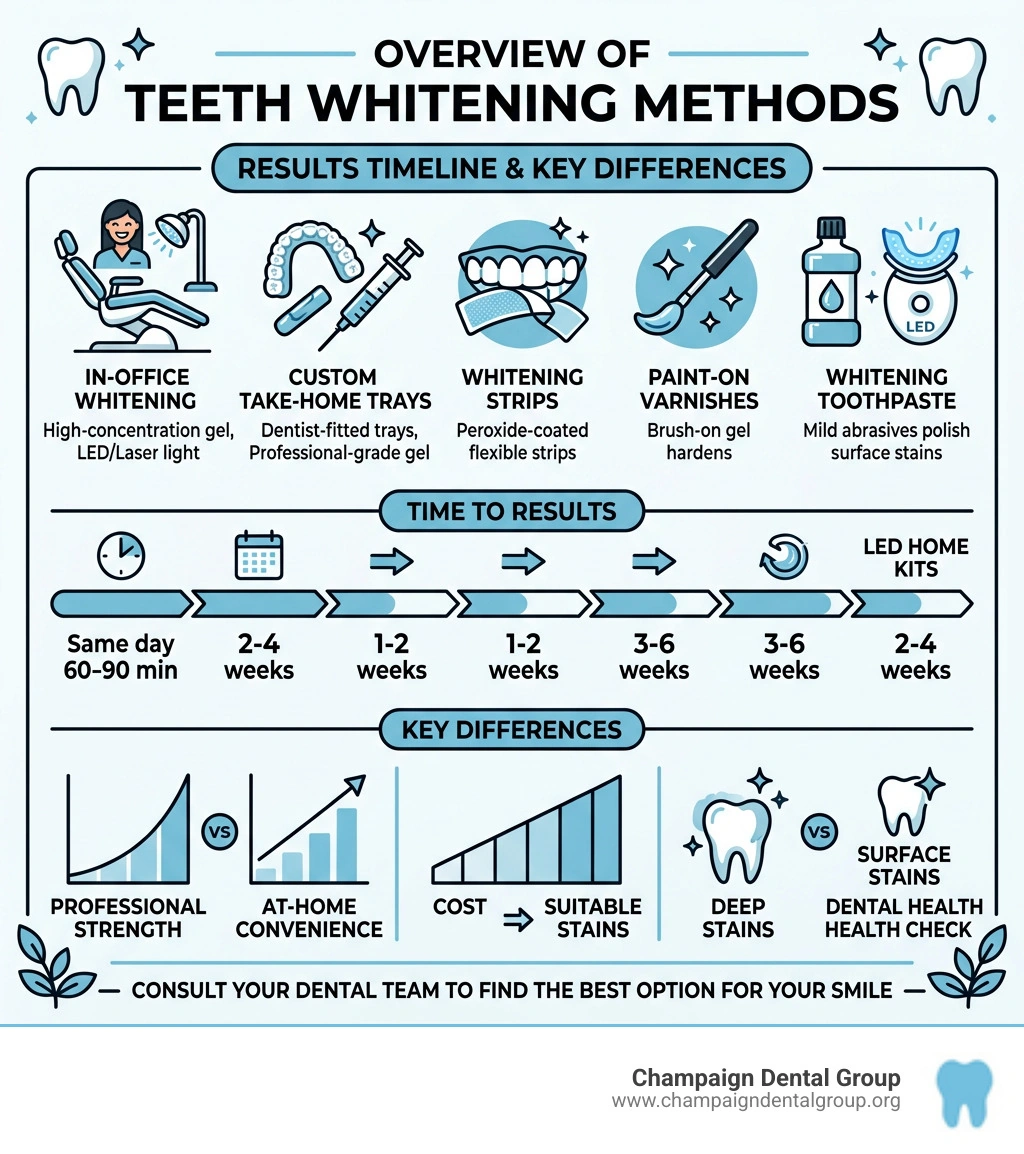
Here's a fast overview of your main options:
In-office whitening: A dentist applies a high-concentration peroxide gel, often with LED or laser light. Results can appear the same day, usually in a 60-90 minute visit.
Custom take-home trays: Dentist-fitted trays hold professional-grade whitening gel against the teeth at home. Results usually take 2-4 weeks.
Whitening strips: Flexible strips coated with peroxide are applied daily. Results often appear in 1-2 weeks.
Paint-on varnishes: A brush-on whitening gel hardens on the teeth, then dissolves. Results usually take 1-2 weeks.
Whitening toothpaste: Mild abrasives help polish away surface stains. Results may take 3-6 weeks.
Whitening rinses: A hydrogen peroxide mouthwash is used daily. Results may take 3-6 weeks.
LED home kits: Peroxide gel is paired with blue light. Results usually take 2-4 weeks.
Most of us want a brighter smile — but the options can feel overwhelming. Toothpaste, strips, lasers, trays... where do you even start?
The good news: you don't need to figure it out alone. A trusted dental team — like the caring, experienced staff at Champaign Dental Group — can point you in the right direction based on your specific teeth and lifestyle.
Whether you're a busy parent squeezing in appointments between school pickups or someone who just wants to look and feel more confident, there's a whitening option that fits your life.
Quick methods of teeth whitening terms:
The Science of a Brighter Smile: How Whitening Works
To understand how to get that "million-dollar smile," we first have to look at what's happening beneath the surface. Your teeth aren't just solid white blocks; they are complex structures. The outer layer is the enamel, the hardest substance in the human body. Underneath that is the dentin, which is naturally a bit more yellow.
When we talk about the science behind brighter smiles, we are usually talking about a chemical process called oxidation. Most professional methods of teeth whitening use bleaching agents like hydrogen peroxide or carbamide peroxide. These chemicals travel through the pores in your enamel to reach the discolored molecules, known as chromophores.
The peroxide breaks the double bonds of these chromophores, effectively "de-coloring" them. This doesn't just scrub the surface; it actually changes the way light reflects off your teeth, making them appear whiter. It's a bit like using a specialized cleaner to get a deep stain out of a white shirt rather than just brushing off the dust on top. According to scientific research on bleaching agents, these agents are highly effective at penetrating the tooth structure to provide lasting change.
Extrinsic vs. Intrinsic Stains
Not all stains are created equal. In our Urbana and Champaign County offices, we categorize stains into two main groups:
- Extrinsic Stains: these are surface-level stains. They come from our daily habits—that morning cup of coffee, the occasional glass of red wine, or tobacco use. Because these sit on the enamel, they are often easier to remove with various whitening options.
- Intrinsic Stains: These are deeper. They live inside the dentin. These can be caused by aging (as enamel thins, more yellow dentin shows through), excessive fluoride exposure during childhood, or certain medications like tetracycline. 2014 research on intrinsic staining notes that these can even be genetic.
Understanding which type you have is the first step we take during a consultation. While a whitening toothpaste might help with extrinsic stains, it won't do much for intrinsic discoloration.
Active Ingredients in Methods of Teeth Whitening
If you look at the back of any whitening product, you’ll likely see one of two names: hydrogen peroxide or carbamide peroxide.
- Hydrogen Peroxide: This is the "fast-acting" version. It breaks down quickly and starts working immediately. It's the primary ingredient in most in-office treatments.
- Carbamide Peroxide: This is essentially hydrogen peroxide stabilized with urea. It breaks down more slowly, making it ideal for products you wear for longer periods, like overnight trays. Interestingly, carbamide peroxide releases about one-third of its weight as hydrogen peroxide.
The concentration of these ingredients varies wildly. Over-the-counter (OTC) products might have a concentration as low as 3%, while professional-grade gels used in our office can go as high as 25-40%. For more details on the chemistry involved, check out this guide on how to whiten enamel.
Professional Methods of Teeth Whitening vs. At-Home Options
When deciding between professional care and a box from the local pharmacy, it usually comes down to three things: speed, safety, and effectiveness.
In-office whitening is the fastest option, often taking about 60-90 minutes. It can deliver dramatic results, sometimes up to 8 shades lighter, with very high-strength whitening gel applied under professional supervision.
Custom trays usually take 2-4 weeks. They use moderate-strength whitening gel in dentist-fitted trays, which helps create more predictable, even results.
Over-the-counter products often take 4-8 weeks. They use lower-strength whitening ingredients, are self-monitored, and usually create a more subtle change.
While OTC products are accessible, they are often "one-size-fits-all." We believe your smile is unique, which is why professional vs. at-home kits is a conversation worth having with your dentist.
In-Office Treatments: Laser and LED Whitening
If you have a wedding next weekend or a big job interview, in-office whitening is your best friend. In a single session lasting about 60 to 90 minutes, we can often enhance the hue of your teeth by up to eight shades.
During this process, we apply a high-concentration gel and then use a specialized light—either a laser or an LED—to "activate" the peroxide. While some LED teeth whitening dentist studies suggest the light mostly helps speed up the reaction, the results are undeniably faster than anything you can do at home.
The biggest benefit of being in the chair? Safety. We use a protective barrier to shield your gums from the strong bleaching agents, which significantly reduces the risk of chemical burns or extreme sensitivity.
Over-the-Counter Methods of Teeth Whitening
For those who prefer a more gradual approach, there are plenty of drugstore options.
- Whitening Strips: These are flexible plastic strips coated with a thin layer of hydrogen peroxide. They are relatively effective for surface stains but can be tricky to keep in place, sometimes leading to uneven whitening if they don't touch every curve of your teeth.
- Paint-on Varnishes: These use an applicator to brush a film onto the teeth. They are low-cost but often provide the most subtle results.
- Whitening Toothpastes: These don't usually "bleach" the teeth. Instead, they use abrasives like baking soda to polish away surface stains. They are great for maintenance but won't change your natural tooth shade.
- Whitening Gums and Rinses: These have the lowest concentration of active ingredients. While whitening gum contains extra abrasives to help scour the surface, they are best used as a supplement to other methods rather than a primary treatment.
Safety First: Candidacy and Managing Side Effects
At Champaign Dental Group, we pride ourselves on providing safe dental whitening. Before we start any treatment, we conduct a thorough exam. Why? Because putting bleaching chemicals on a tooth with an undiagnosed cavity is a recipe for a very painful afternoon!
The two most common side effects are tooth sensitivity and gum irritation. Sensitivity happens because the peroxide temporarily opens the microscopic tubules in your dentin, allowing temperature changes to reach the nerve more easily. This is usually temporary, but it's something we manage closely.
Who Should Avoid Whitening?
While most people are great candidates, there are some groups who should hit the "pause" button:
- Pregnant or Breastfeeding Individuals: There isn't enough research to prove it's 100% safe for the baby, so we usually recommend waiting.
- Children and Adolescents: The American Academy of Pediatric Dentistry generally discourages full-arch bleaching for those with primary or mixed dentition.
- People with Gum Disease or Unfilled Cavities: We need to get your mouth healthy first.
- Those with Restorations: This is a big one. Bleaching agents only work on natural tooth structure. If you have crowns, veneers, or fillings on your front teeth, they will stay the same color while the rest of your teeth whiten, leading to a mismatched look.
Managing Sensitivity During Methods of Teeth Whitening
If you have sensitive teeth, don't give up on your dream of a bright smile! We have several tricks up our sleeves:
- Lower Concentrations: We can use a gentler gel over a longer period.
- Desensitizing Agents: Using toothpastes with potassium nitrate or sodium fluoride for two weeks before treatment can help "plug" those tubules and reduce discomfort.
- Shorter Sessions: Sometimes, less is more.
For more tips, read our full guide on safe dental whitening.
Maintaining Your Results and Affordable Care
You’ve done the work, you’ve got the glow—now how do you keep it? On average, the effects of professional whitening can last up to three years, but that depends heavily on your lifestyle.
- The "White Diet": For the first 48 hours after treatment, your teeth are extra porous. Avoid coffee, tea, red wine, soy sauce, and tobacco. If it would stain a white tablecloth, it will stain your teeth!
- Regular Cleanings: Professional cleanings in our Urbana or Champaign offices remove the plaque that stains cling to.
- Touch-ups: If you use custom-fit trays, you can do a one-night touch-up every 6 months to keep things bright.
We know that many patients worry about the cost of dental bleaching. We believe everyone deserves a smile they are proud of, regardless of their insurance status. That’s why we offer the Champaign Dental Smile Protection Plan. This plan is designed to make high-quality, affordable dental care accessible to our community, ensuring you can maintain your oral health and your bright smile without breaking the bank.
Frequently Asked Questions
Can teeth whitening be done on crowns or fillings?
As mentioned earlier, the answer is no. Whitening products are designed to react with organic tooth enamel. Synthetic materials like porcelain or composite resin used in crowns and fillings will not change color. If you are planning on getting new crowns or veneers, we often recommend whitening your natural teeth first so we can match the new restoration to your new, brighter shade.
How long do professional whitening results last?
With proper care, you can expect your results to last between one and three years. Factors like smoking, drinking dark liquids, and your natural aging process will eventually cause some "fade back." Using a whitening toothpaste once or twice a week can help maintain the results longer.
Are whitening rinses and gums effective?
They are the least effective methods of teeth whitening. Rinses are only in contact with your teeth for about 60 seconds, which isn't long enough for the peroxide to penetrate the enamel deeply. However, they are excellent at preventing new stains from forming. Whitening gum is great for after-meal cleaning because it stimulates saliva, which naturally washes away food particles, but don't expect it to do the heavy lifting of a professional treatment.
Conclusion
A million-dollar smile shouldn't feel out of reach. At Champaign Dental Group, we’ve been serving the Urbana and Champaign County communities since 1997 with a simple mission: providing compassionate, high-quality care using state-of-the-art technology.
Our staff is dedicated to making sure you feel comfortable from the moment you walk through our doors. Whether you are interested in professional tooth whitening or simply need a routine check-up, we are here to help you achieve your goals with a personalized touch.
Ready to see what the right methods of teeth whitening can do for you? Request an appointment with us today and let’s get started on your brighter, more confident smile!