.jpg)
Medical Insurance & Dental Implants: What You Need to Know

Understanding Medical Insurance Coverage for Dental Implants
Will medical insurance cover dental implants? The short answer is: sometimes, but only under specific circumstances. Here's what you need to know:
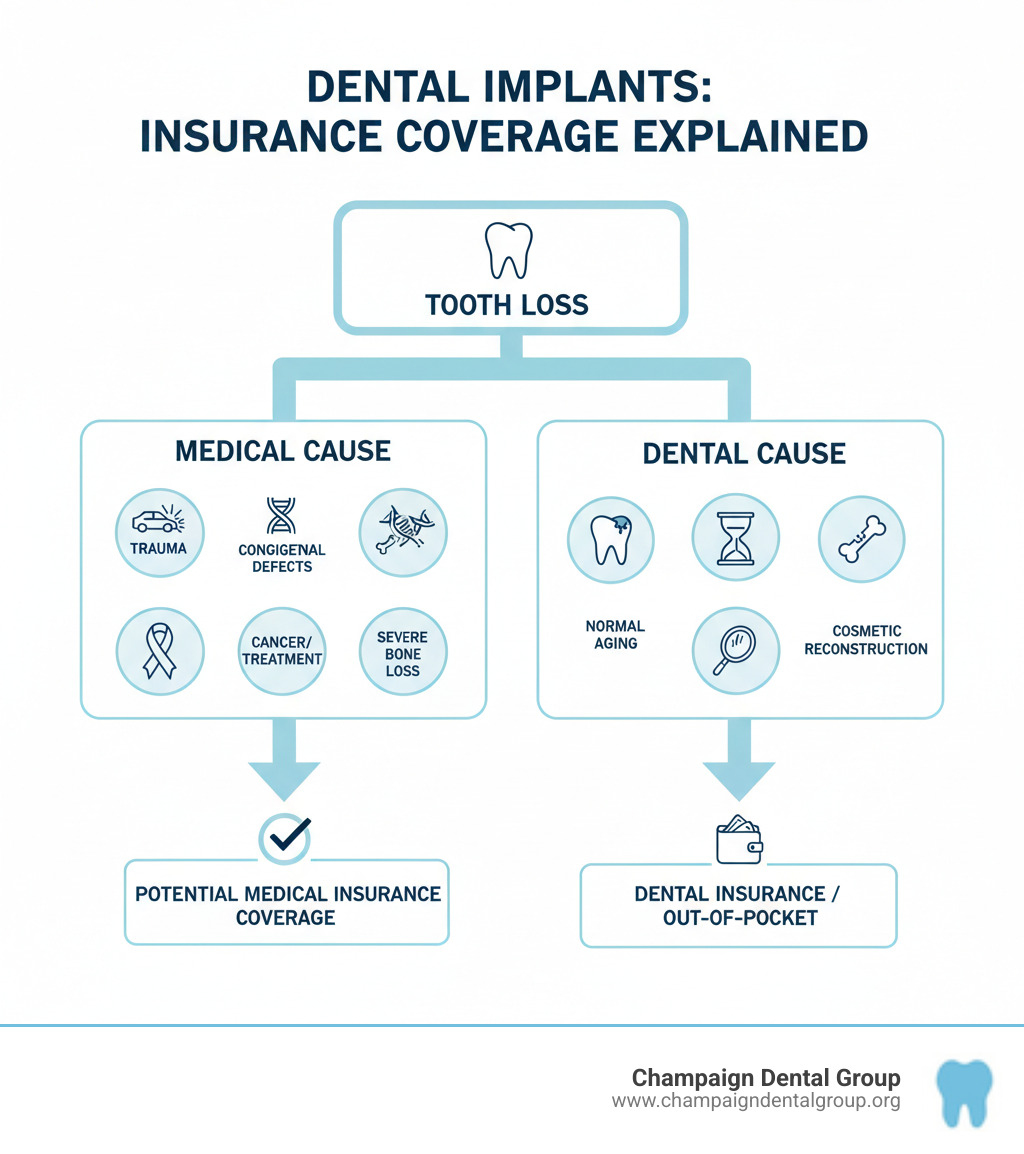
Medical insurance may cover dental implants when:
- You lost teeth due to a traumatic accident (car crash, sports injury, fall)
- You have a congenital defect affecting tooth development (ectodermal dysplasia, anodontia)
- You lost teeth due to oral cancer or cancer treatment
- You have severe bone atrophy making conventional dentures impossible
Medical insurance typically will NOT cover dental implants for:
- Tooth loss from decay or gum disease
- Cosmetic reconstruction
- Normal age-related tooth loss
Many people are surprised to learn that dental implants might be covered by their medical insurance rather than their dental plan, but only if the tooth loss is deemed "medically necessary."
Dental implants sit in a gray area between dental and medical care. While placed in your mouth, they can address serious medical issues like bone loss, chewing dysfunction, and trauma recovery.
This guide explains when medical insurance covers dental implants, what documentation you need, and how to build a strong case for coverage. We'll also cover what to do if your claim is denied and explore alternative ways to make implants affordable for your family.
At Champaign Dental Group, our compassionate team has helped countless families steer insurance complexities. We understand that figuring out payment options can feel overwhelming when you're already dealing with tooth loss. Our staff is dedicated to providing exceptional patient care and will work with you to explore all possible coverage options.
The Great Divide: Medical vs. Dental Insurance for Implants
Navigating medical and dental insurance for implants can be tricky. The two systems are managed by different companies with different rules. Your dental insurance is designed for routine care like cleanings and fillings, while your medical insurance covers the rest of your body, from doctor visits to surgeries.
However, doctors now recognize the oral-systemic connection—the link between your mouth and your overall health. When tooth loss stems from a medical event like an accident, cancer treatment, or a birth defect, it's no longer just a dental issue; it's a medical condition. This creates a gray area where it becomes a real possibility that medical insurance will cover dental implants.
At Champaign Dental Group, our experienced team has helped countless families steer this confusing landscape. Our staff is dedicated to providing exceptional patient care, and that includes helping you understand your coverage options. For more insights, check out our guide on Dental Implants and Insurance.
Understanding Dental Insurance Limitations
While dental insurance seems like the obvious choice, it has significant limitations for implants:
Annual Maximums: Most plans cap yearly payouts at $1,000 to $2,000. This limit is often quickly reached with a procedure like dental implants, leaving you with significant out-of-pocket costs.
Waiting Periods: Many plans require a waiting period of four to twelve months after enrollment before they cover major services like implants.
Coinsurance: Even after meeting your deductible, most plans only pay 50% of the cost for major procedures like implants, leaving you responsible for the other half.
Major Service Classification: Implants are classified as a major service, which always receives the lowest coverage percentage. Some plans exclude them entirely, viewing them as cosmetic.
Despite these limitations, dental implants offer incredible long-term value. They prevent bone loss and restore full chewing function. Learn more in our article on the Benefits of Dental Implants.
How Medical Insurance Views Dental Procedures
Medical insurance asks a different question: Is this procedure necessary to restore function or treat a medical condition?
Focus on Function: Medical insurance cares whether you can chew properly, speak clearly, and maintain nutrition. If tooth loss from a medical event compromises these functions, it may step in.
Systemic Health Impact: When dental problems affect your overall health, such as severe jawbone loss that alters your facial structure, medical coverage becomes more likely.
Cause of Tooth Loss: This is the most important factor. Medical insurance draws a clear line between dental causes (decay, gum disease) and medical causes (accidents, genetic conditions, cancer treatment).
Billing Codes: Medical insurance uses CPT codes, while dental uses CDT codes. For medical coverage, the surgical aspects of the implant procedure must be billed using the correct medical codes.
Understanding these distinctions is essential when determining if medical insurance will cover dental implants.
| Feature | Medical Insurance (for Implants) | Dental Insurance (for Implants) |
|---|---|---|
| Common Reasons for Coverage | Traumatic injury, congenital defects, oral cancer treatment, severe bone atrophy | Tooth replacement for functional chewing (often limited) |
| Primary Focus | Overall health, systemic impact, restoration of function due to medical condition | Oral health, preventative care, basic and major dental services |
| Key Differentiator | Medical necessity (cause of tooth loss is non-dental) | Functional replacement (cause of tooth loss is dental) |
| Typical Out-of-Pocket | Deductibles, co-pays, co-insurance (can be substantial but often lower for medically necessary procedures once deductible is met) | Deductibles, co-insurance (often 50% for major services), annual maximums often quickly reached |
| Documentation Required | Letter of Medical Necessity (LMN), detailed medical reports, imaging, physician's statement, treatment plan with CPT codes | Detailed treatment plan, X-rays, pre-authorization (CDT codes) |
| Pre-Authorization | Usually required and highly recommended | Often required for major services |
| Exclusions | Tooth loss from decay, gum disease, cosmetic reconstruction | Often explicit exclusion of implants, or limited coverage with many restrictions |
When Will Medical Insurance Cover Dental Implants? The "Medical Necessity" Rule
The key to getting medical insurance to cover dental implants is proving "medical necessity." This means the treatment is essential for an illness, injury, or medical condition, not just for cosmetic or convenience reasons. If you lose a tooth to decay, it's a dental problem. If you lose teeth in a car accident, it's a traumatic medical event.

The medical necessity of implants often centers on preventing jawbone deterioration. When you lose a tooth, the jawbone begins to resorb, or dissolve away. This can change your facial structure and make it impossible to wear dentures or chew properly. Implants become medically necessary because they preserve the jawbone and restore function, preventing further health complications.
At Champaign Dental Group, our compassionate team is committed to helping you understand if implants are the right medical solution for you. You can learn more in our guide, The Advantages of Dental Implants Is It Right For You.
Qualifying Conditions for Medical Necessity
Certain situations consistently open the door for medical coverage of dental implants:
Traumatic Injury: If you lose teeth in an accident, fall, or sports injury, medical insurance often covers implants as the loss resulted from a medical event. Policies usually require replacement within a specific timeframe (e.g., 12-24 months) and exclude injuries from chewing.
Congenital Defects: Conditions present at birth like ectodermal dysplasia or anodontia (missing teeth) are developmental medical issues, not dental problems. When these interfere with function, implants may be covered as medically necessary.
Disease-Related Tooth Loss: Implants are often considered medically necessary for reconstruction after tooth loss from oral cancer or its treatment (e.g., radiation). Coverage typically applies if the loss interferes with function.
Severe Bone Atrophy: In cases of extreme jawbone loss where conventional dentures cannot be stabilized, implants may be the only viable solution to restore jaw structure and the ability to eat and speak.
Our experienced team at Champaign Dental Group understands these conditions and has helped countless patients build strong cases for medical coverage. The high quality of care our staff provides extends beyond the dental chair—we're your advocates in dealing with insurance.
Why implants are a medically necessary solution, not just cosmetic
When we ask will medical insurance cover dental implants, we're talking about a treatment that addresses serious health concerns, not just aesthetics.
Bone Preservation: Implants are the only option that replaces the tooth root, stimulating the jawbone and preventing the bone loss (resorption) that occurs after tooth loss. This preserves your facial structure and protects your jaw's integrity.
Restoring Chewing Function: Missing teeth can limit your diet, leading to nutritional deficiencies. Implants restore nearly 100% of your natural chewing ability, allowing you to eat a healthy, varied diet.
Preventing Adjacent Teeth from Shifting: When a tooth is lost, neighboring teeth drift into the gap, causing bite problems and misalignment. Implants act as placeholders, protecting your remaining teeth.
Compared to bridges (which require grinding down healthy teeth) and dentures (which don't stop bone loss), implants are a superior medical solution. They are permanent and function like natural teeth. For a detailed comparison, read our article on Bridge vs Implant. Insurance policies recognize these benefits; Cigna's medical policy on dental implants, for example, outlines specific criteria for when implants are medically necessary.
How to Build Your Case and Determine if Medical Insurance Will Cover Dental Implants
Getting approval for medical coverage of dental implants isn't about luck—it's about preparation, documentation, and advocacy. You don't have to steer this process alone.
At Champaign Dental Group, our compassionate team has walked countless families through the insurance maze. We partner with you every step of the way, using our experience to build the strongest possible case for coverage.

Step 1: Thoroughly Review Your Insurance Policy
Before anything else, become an expert on your medical insurance policy. This is essential detective work.
Review Key Documents: Start with your Summary of Benefits and Coverage (SBC). Look for sections on oral surgery or reconstructive procedures. Then, check the policy exclusions for any exceptions related to medical necessity, trauma, or congenital defects.
Understand Definitions: Find your policy's specific definition of "medically necessary." Your entire case will be built on meeting this definition.
Check Your Network: See if your plan distinguishes between in-network and out-of-network providers. Choosing an in-network oral surgeon can save you thousands.
Call Your Insurer: If anything is unclear, call your insurance company. Ask specific questions like, "Does my plan cover implants if the tooth loss was from a car accident?" Document the date, time, and name of every person you speak with. Many insurers also have online portals to Check coverage under my plan.
Step 2: Partner with Your Dentist for Documentation
Your dental team is your primary advocate. At Champaign Dental Group, we specialize in building compelling cases for insurance coverage and know what providers are looking for.
Detailed Treatment Plan: We create a comprehensive plan that explains why implants are the most appropriate and medically necessary solution for you, especially if other treatments like dentures are not viable.
Letter of Medical Necessity (LMN): This is your most powerful tool. Written by your dentist, this personalized letter details your diagnosis, explains how your condition impairs function (chewing, speaking), and justifies why implants are the standard of care, including relevant CPT medical billing codes.
Supporting Documentation: We will help you gather all necessary X-rays, CT scans, photos, and reports from other medical specialists (e.g., ER reports, oncologist's notes) to strengthen your case.
Our team is exceptionally skilled at preparing this comprehensive package. We also have experience in Crowns and Implants Dentistry, which may be part of your overall treatment plan.
Step 3: Submit for Pre-Authorization
This is perhaps the most important step. Pre-authorization is your insurer's official confirmation that a service is deemed medically necessary and will be covered. It's a critical step to avoid unexpected costs and understand your estimated out-of-pocket expenses upfront.
Our dedicated team at Champaign Dental Group typically handles the entire pre-authorization process for our patients. We submit the request with all the necessary documentation in the format insurance companies expect.
Once submitted, it's important to follow up regularly with your insurance provider. Be polite but persistent, and promptly provide any additional information they request. Throughout this process, our patient care team remains your partner. We understand how stressful insurance claims can be, and our staff is here to handle communications and ensure you feel supported. That's the level of compassionate, high-quality care we've been providing to Champaign County families since 1997.
What If Your Claim Is Denied? Exploring Other Financial Avenues
A denial from your medical insurance isn't the end of the road. You have the right to appeal, and our team at Champaign Dental Group can help. Beyond appeals, several financial strategies can make dental implants accessible, regardless of whether medical insurance will cover dental implants.
These options have helped many of our patients move forward with the care they need. For more information, visit our guide on Financing Dental Procedures.
Using Pre-Tax Health Accounts
Using pre-tax health accounts is a smart way to reduce the overall cost of dental implants through significant tax savings.
Health Savings Accounts (HSAs): Available with high-deductible health plans, HSAs offer a triple tax advantage. Contributions are tax-deductible, funds grow tax-free, and withdrawals for qualified medical expenses (like dental implants) are tax-free. Funds also roll over annually.
Flexible Spending Accounts (FSAs): Offered through employers, FSAs allow you to contribute pre-tax money from your paycheck for healthcare expenses. Most FSAs are "use it or lose it" within the plan year, so it's important to time your treatment accordingly.
You can Learn the difference between an FSA and an HSA to see which is best for your family.
In-House Plans and Dental Financing
At Champaign Dental Group, we believe financial barriers shouldn't prevent you from getting a healthy smile. We offer multiple pathways to make implants affordable for families in Urbana and Champaign County, OH.
Our Smile Protection Plan: This in-house membership is designed for patients who want quality dental care without the hassles of traditional insurance. It offers significant discounts on procedures like dental implants, making it easier to budget for treatment.
Third-Party Financing: We partner with reputable healthcare lending companies that offer flexible payment plans. These plans break down the cost of treatment into manageable monthly payments, often with low-interest or zero-interest promotional periods.
The caring team at Champaign Dental Group has served our community since 1997. Our commitment goes beyond providing state-of-the-art dental technology—we're dedicated to ensuring every patient receives compassionate, high-quality care and has access to the treatment they need. We will discuss all payment options with you to create a plan that works for your family.
For more details, check out our guides on Dental Loans for Implants and Affordable Dental Care Options.
Frequently Asked Questions about Medical Insurance and Dental Implants
We understand you have questions about if medical insurance will cover dental implants. Here are answers to some of the most common ones we hear from our patients in Urbana and Champaign County, OH.
Are dental implants ever covered for tooth loss from gum disease or decay?
Generally, no. Medical insurance views tooth loss from gum disease or decay as a preventable dental issue, not a medical necessity. Your dental insurance, however, might offer partial coverage. The amount covered will depend on your specific plan's benefits, annual maximums, and waiting periods for major services. Our team at Champaign Dental Group is here to help you understand what your plan covers.
Does Medicare cover dental implants?
Original Medicare (Parts A and B) does not cover routine dental care, including dental implants. However, some private Medicare Advantage (Part C) plans may offer limited dental benefits. It's crucial to review your specific Part C plan's documents or contact the provider directly, as comprehensive implant coverage is still rare.
Our compassionate team at Champaign Dental Group has extensive experience working with Medicare patients and can help guide you through understanding your coverage options.
How can I find out if my specific medical plan will cover dental implants?
The best way to determine if your medical insurance will cover dental implants is to call your insurance provider directly. Have your policy number and medical diagnosis (e.g., trauma, congenital defect) ready. Ask about coverage for specific CPT (medical) codes for implant surgery, which our team at Champaign Dental Group can provide before you call.
Always request written confirmation of any coverage approval and keep a detailed record of your conversations. We know navigating insurance is overwhelming. Our compassionate team is here to assist you every step of the way, from gathering documents to guiding you on what questions to ask. At Champaign Dental Group, we're committed to providing exceptional patient care that extends beyond the dental chair.
Your Partners in Navigating Implant Costs and Care
Navigating insurance for dental implants can be overwhelming, but you don't have to do it alone. The process involves reviewing your policy, building a case for medical necessity, and exploring financial options if needed.
At Champaign Dental Group, we've been serving families in Urbana and Champaign County, OH since 1997. Our experienced team understands that dealing with insurance companies is frustrating, and we are committed to standing beside you every step of the way.
Our compassionate staff will work diligently to help you understand your options and maximize your coverage. We assist with reviewing policies, preparing detailed documentation like letters of medical necessity, and handling pre-authorization requests. We know what insurance companies look for and will present your case in the strongest possible way.
If insurance doesn't cover your implants, we offer solutions. Our Smile Protection Plan provides affordable access to high-quality dental care. We also partner with third-party financing companies that offer flexible payment plans. You can learn more in our guides to Financing Dental Procedures and Affordable Dental Care Options.
Your oral health is an essential part of your overall well-being. We believe everyone deserves a healthy, functional smile. Our team is dedicated to providing exceptional, high-quality patient care and finding solutions that work for your unique situation.
Ready to take the next step? We'd love to meet with you, discuss your specific situation, and help you understand all your options for coverage and payment.