.jpg)
All About Tooth Cap Costs with a Savings Plan

How a Dental Savings Plan Can Reduce Your Tooth Cap Cost
Understanding tooth cap cost with savings plan discounts can mean the difference between putting off a crown and getting it done this week. Here is a quick look at what you can expect:
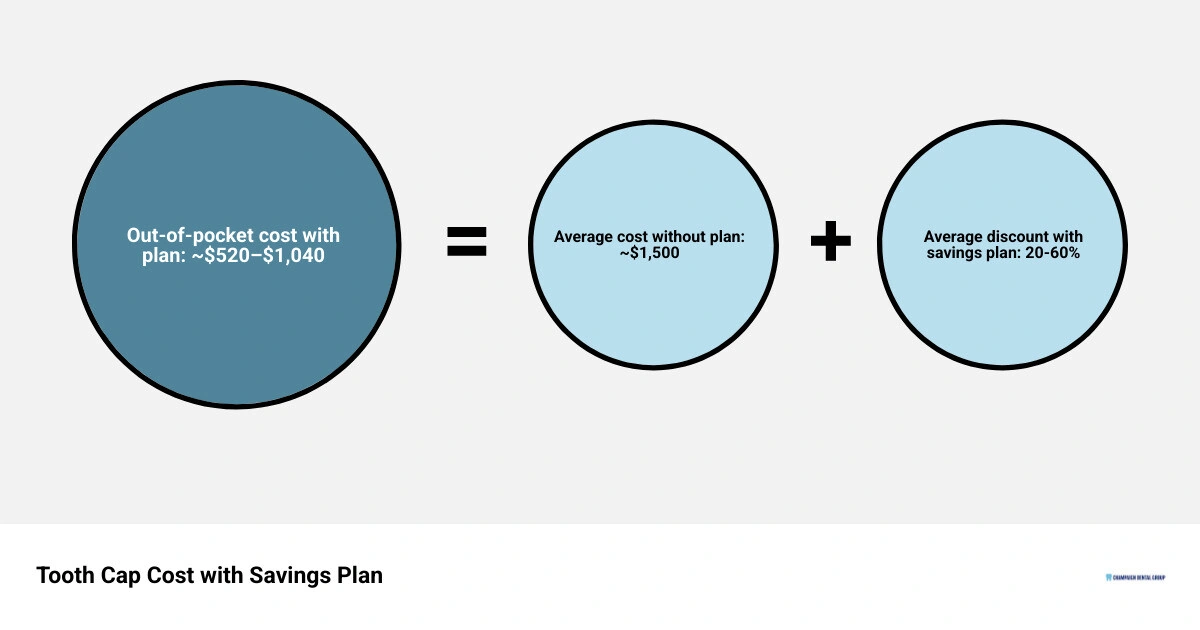
- Without any plan: A single dental crown typically runs between $800 and $2,500, depending on the material and where you live.
- With a dental savings plan: A 20-60% discount brings that range down to roughly $520-$1,040 out of pocket.
- Plan cost: Most dental savings plans run around $99-$149 per year, so even one crown more than pays for the membership.
- No waiting period: Savings plans usually activate within a few business days, so you can use the discount at your very first appointment.
- No annual cap: Unlike traditional dental insurance, savings plans do not stop covering you once you hit a yearly limit.
If you need a crown soon and do not have dental insurance, a savings plan is often the fastest and most affordable path forward.
A lot of our patients in Champaign County come to us after putting off a cracked or weakened tooth for months, mostly because the cost feels overwhelming. That hesitation is completely understandable. Dental work is not cheap, and without insurance, a single crown can feel like an impossible bill. But the good news is that there are real, practical ways to make it affordable, and you do not have to figure it out alone.
I'm Dr. Ellen Zwick, and at Champaign Dental Group we have been helping families in Urbana and across Champaign County navigate exactly this kind of decision since 1997, including through our own Smile Protection Savings Plan designed for patients without traditional insurance.
What Is a Tooth Cap and Why Do You Need One?
To understand how to save on this procedure, it helps to know exactly what you are paying for. A tooth cap, which dentists officially call a dental crown, is a custom-made cover that fits snugly over a damaged, decayed, or weakened tooth. Think of it as a protective helmet for your tooth. It restores the tooth's shape, size, and strength, allowing you to chew comfortably and smile without feeling self-conscious.
We typically recommend a crown when a tooth has suffered too much damage for a standard filling to fix. This often happens due to:
- A deep cavity that has weakened the surrounding tooth structure.
- A cracked or fractured tooth that hurts when you bite down.
- A tooth that has recently undergone root canal therapy and needs to be sealed and protected.
- Extreme wear and tear from years of clenching or grinding.
By completely covering the vulnerable area, a crown prevents further cracking and protects the nerve inside. If you want to explore how we design and place these restorations, you can find More info about crown services on our dedicated service page.
Understanding Dental Crown Materials and Longevity
Not all crowns are created equal, and the material your dentist uses plays a major role in both how long the crown lasts and how much it will cost.
- Porcelain and Ceramic: These are highly popular because they can be precisely color-matched to your surrounding teeth. They are the go-to choice for highly visible front teeth where aesthetics matter most.
- Zirconia: Known for its incredible durability, zirconia is a modern metal-free material that can withstand heavy chewing forces. We often recommend it for back molars.
- Gold Alloy and Metals: While not tooth-colored, gold and metal alloys are exceptionally gentle on opposing teeth and rarely chip. They are incredibly long-lasting, making them a fantastic choice for out-of-sight back teeth.
To dive deeper into how these materials compare in durability and general market pricing, read through How Much Does a Dental Crown Cost? 2026 Prices by Material.
How Much Does a Tooth Cap Cost Without Insurance?
When you do not have a dental insurance policy, paying for a crown entirely out of pocket can feel like a heavy financial lift. The final price tag is not just a single flat fee; it represents the high-quality materials used, the advanced technology required to shape the cap, and the time and expertise of your dental team.
Without some kind of discount or savings program, you are responsible for the full retail rate of the crown. This retail rate is what dentists call their "usual and customary" fee. Because this fee covers the specialized dental laboratory that custom-crafts your crown, the cost of the temporary crown, and multiple appointments, the out-of-pocket expense can quickly add up.
To get a broader perspective on national averages and what patients typically pay across the country, check out How Much Does a Tooth Cap Cost? 2026 Dental Crown Prices USA. You can also read our detailed local breakdown, What Is The Average Cost Of A Dental Cap, to see how these costs take shape closer to home.
Hidden Fees and Additional Restorative Costs
One mistake we often see patients make is budgeting solely for the crown itself, only to be surprised by separate charges for necessary preparatory work. A crown cannot simply be glued onto a badly decayed tooth. First, the foundation of the tooth must be healthy and strong.
These necessary preparatory procedures can include:
- Comprehensive Exams and X-rays: To assess the health of the tooth's root.
- Core Buildup: A procedure where the dentist uses filling material to rebuild the base of the tooth so it can securely hold the new crown.
- Root Canal Therapy: If the decay has reached the nerve of the tooth, a root canal must be completed before the crown is placed to prevent severe pain and infection.
When you factor in these additional steps, the total cost of saving a single tooth can increase significantly. To understand how these preparatory treatments are priced and why they are necessary, take a look at our guide on Root Canal Treatment Cost.
Understanding Your tooth cap cost with savings plan Memberships
For families and individuals without insurance, a dental savings plan (sometimes called a dental discount plan) acts as an affordable membership program. You pay a simple annual or monthly fee to join, and in return, you gain access to pre-negotiated, discounted rates on almost every procedure the practice offers.
Unlike insurance, there are no claims to file, no confusing deductibles to meet, and no insurance representatives deciding whether your crown is "medically necessary." You simply show your membership card, receive your discount, and pay the reduced fee directly to the office at the time of your visit.
To learn more about how these plans are structured and why they have become so popular for restorative care, you can read How Much Does a Dental Crown Cost With a Savings Plan? (2026).
How to Lower Your tooth cap cost with savings plan Benefits
One of the biggest advantages of utilizing a dental savings plan is the sheer speed of the savings. If you wake up on a Saturday morning with a cracked tooth, you cannot afford to wait months for an insurance policy to kick in.
With an in-house savings plan, like our Smile Protection Savings Plan at Champaign Dental Group, your benefits are active the very same day you sign up. There are absolutely no waiting periods. This means you can walk into our Urbana office, sign up for the plan at the front desk, and immediately receive a significant percentage off your crown and any necessary prep work during that same appointment.
For more details on how uninsured patients use these plans to bypass traditional insurance hurdles, explore Discount Dental Caps, Need a Dental Cap with No Dental Insurance.
Comparing Your Out-of-Pocket tooth cap cost with savings plan vs. Insurance
When deciding between traditional dental insurance and a dental savings plan, the math often favors the savings plan, especially for major restorative work like crowns.
Most traditional insurance plans have a strict annual maximum limit. Once the insurance company pays out that maximum amount in a calendar year, they stop covering your care entirely. Because a crown and its preparatory work (like a core buildup or root canal) can easily reach or exceed that annual limit, insurance often leaves patients paying a large portion of the bill out of pocket anyway.
A dental savings plan, on the other hand, has no annual limits. Whether you need one crown, three crowns, or a combination of crowns and fillings, your member discount applies to every single dollar of your treatment plan, all year long.
To see a detailed mathematical breakdown of how these savings compare, read through Dental Savings Plans 2026: What They Really Save, by State.
What Factors Influence Your Final Out-of-Pocket Bill?
Your final out-of-pocket cost for a crown is influenced by several real-world factors:
- The Position of the Tooth: Front teeth require highly aesthetic, hand-layered ceramic materials to look natural, which can carry higher laboratory fees. Back teeth require high-strength materials like zirconia to withstand chewing forces.
- The Complexity of the Preparation: If your tooth requires a post, a core buildup, or gum contouring before the cap can be placed, your total bill will reflect those additional steps.
- The Specialist vs. General Dentist: Seeing a specialist (like a prosthodontist) can sometimes result in higher fees compared to receiving your crown from a trusted family dentist.
To see how standard fee schedules apply to different types of crowns and materials, you can review Dental Costs at the Dentist for CAPS Dental Plan Members - CAPS Dental Plan.
Midwest Regional Pricing and Local Savings
Where you live has a major impact on dental fees. Dental costs on the East and West Coasts are traditionally much higher than they are here in the Midwest.
Here in Urbana and the surrounding Champaign County communities, we are proud to offer high-quality care that reflects our local values. We do not believe in the high-pressure, high-volume corporate dental model. Instead, we focus on honest, transparent pricing that makes sense for our neighbors in Mechanicsburg, West Liberty, Tremont City, and Springfield.
To understand how local factors shape the cost of dental crowns in our state, take a look at our article on Dental Crown Cost Ohio.
Frequently Asked Questions About Tooth Cap Costs
How long does a dental crown typically last?
With excellent oral hygiene and regular professional cleanings, a high-quality dental crown can easily last between 10 and 15 years, and often much longer. Gold and zirconia crowns are particularly durable. To maximize your crown's lifespan, we recommend brushing twice daily, flossing around the base of the crown, and wearing a custom nightguard if you tend to grind your teeth at night. For a complete guide on caring for your new restoration, check out the Ultimate Guide Dental Caps 2026.
Can I get a same-day crown with a savings plan?
Yes, many modern practices offer same-day crowns using advanced digital milling technology. This allows the dentist to scan, design, and mill your custom crown right in the office, saving you from wearing a temporary cap and returning for a second appointment. At Champaign Dental Group, we are committed to using advanced restorative materials to give you a beautiful, durable result. To learn more about how all-porcelain and ceramic options compare, read our article on Crown All Porcelain.
What happens if I delay getting a tooth cap?
Delaying a crown on a severely damaged or root-canaled tooth is highly risky. Without the protective cap, the remaining tooth structure is incredibly brittle and can easily fracture all the way down to the root. If the root fractures, the tooth can no longer be saved and must be extracted. Replacing an extracted tooth requires more complex and expensive treatments, such as a dental bridge or a dental implant. To understand the long-term financial and physical consequences of tooth loss, read our guide on Single Tooth Implant Cost Without Insurance.
Conclusion
At Champaign Dental Group, we have been proud to serve as a trusted cornerstone of the Urbana community since 1997. We treat our patients like family, not numbers on a spreadsheet. We know that dental anxiety is real, and we know that worrying about how to pay for your care only makes that anxiety worse.
That is why we created our Smile Protection Savings Plan. It is our way of ensuring that our neighbors across Champaign County, from West Liberty to Mechanicsburg, can access the compassionate, high-quality care they deserve without financial stress. Whether you need a simple cleaning, a restorative crown, or comfortable sedation options for your peace of mind, we are here to help you smile again.
If you are ready to discuss your options and get a transparent, personalized estimate for your dental care, please Request an Appointment with our warm and welcoming team today.