.jpg)
Everything You Should Know About Composite Bonding Teeth

Composite Bonding Teeth: The Quick, Affordable Way to a Better Smile
Composite bonding teeth is a cosmetic dental treatment where a tooth-colored resin is applied directly to your teeth to repair, reshape, or improve their appearance — usually in a single visit, with little to no discomfort.
Here's a quick summary of what you need to know:
- What it fixes: Chips, cracks, gaps, stains, and uneven teeth
- How long it takes: 30–60 minutes per tooth, typically one visit
- How long it lasts: 3–10 years with proper care
- Is it painful? Usually not — anesthesia is rarely needed
- Is it reversible? Yes — it removes little to no natural enamel
- How it compares: More affordable and less invasive than veneers or crowns
It's one of the most accessible cosmetic dental options available today — and it can make a real difference in how you feel about your smile.
For busy parents juggling packed schedules, the appeal is clear: no lengthy treatment plans, no major procedures, just a quick appointment and results you can see right away. At Champaign Dental Group, our caring team makes the process smooth and stress-free from start to finish.
Read on to get the full picture — from how the procedure works, to how long results last, to whether it's the right fit for your smile goals.
Composite bonding teeth terms to remember:
What is Composite Bonding Teeth?
If you have ever wondered how dentists can seemingly "sculpt" a new smile in under an hour, the answer is likely composite bonding teeth. At its core, this procedure involves the application of a tooth-colored composite resin—a durable, biocompatible plastic material infused with glass particles—to the surface of a tooth.
Unlike crowns or traditional veneers, which are fabricated in a lab and then "cemented" on, bonding is a form of direct-composite-bonding. This means we apply the material directly to your tooth, shape it by hand, and harden it right there in the chair. It is a cornerstone of adhesive dentistry, a field focused on using specialized materials to create a strong, seamless bond between the natural tooth and the restorative resin.
According to WebMD, the resin is putty-like when first applied, allowing your dentist to mold it into the perfect shape to hide imperfections. Because the resin comes in various shades, we can match it perfectly to your surrounding teeth, making the repair virtually invisible to the naked eye.
The Step-by-Step Procedure
One of the best things about composite bonding teeth is its simplicity. You don't need to clear your entire week for recovery; in fact, most patients head straight back to work or school immediately after their appointment.
Preparing for Your Composite Bonding Teeth Appointment
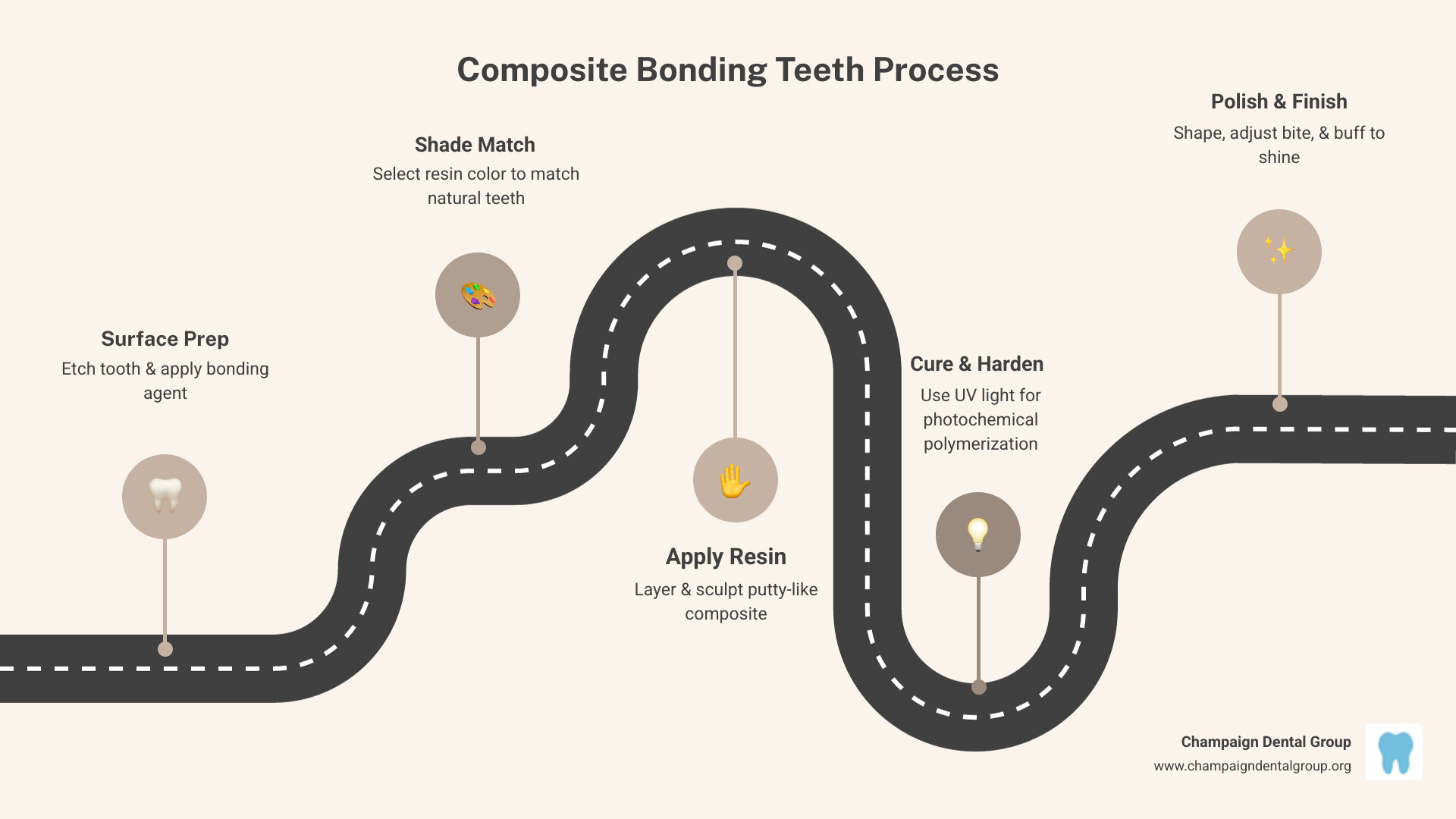
The journey to a better smile begins with a consultation at our Champaign or Urbana locations. We start by using a shade guide to select the composite resin color that matches your natural teeth most closely. If you are planning to whiten your teeth, we usually recommend doing that before the bonding, as the resin material does not respond to whitening gels once it is set.
Preparation is minimal. Unlike veneers, which require the removal of a significant amount of enamel, bonding usually only requires us to "roughen" the surface of the tooth slightly. We then apply a conditioning liquid. This process, as detailed in our direct-bonding-teeth-before-after-guide, helps the bonding material adhere securely to the tooth. Because the procedure is so non-invasive, anesthesia is rarely necessary unless we are also filling a cavity.
Application and Curing
Once the tooth is prepared, the magic happens:
- Layering: We apply the putty-like resin in layers. This allows us to build up the tooth's structure and control the final shape and translucency.
- Sculpting: Our skilled dentists mold and smooth the resin to the desired shape, ensuring it looks natural and fits your bite.
- Hardening: We use a specialized UV curing light or laser to harden the material. This process is called photochemical polymerization. It transforms the soft resin into a hard, durable surface in seconds.
- Finishing: After the resin has hardened, we further trim and shape it. The final step is a high-grade polish to give the tooth a natural sheen that mimics the gloss of real enamel.
Benefits and Common Uses
Why do so many patients choose composite bonding teeth? It is incredibly versatile. Whether you had a minor mishap with a fork or have lived with a gap your whole life, bonding can likely help.
- Chipped or Cracked Teeth: Even a small chip can make you feel self-conscious. Bonding restores the tooth's original shape seamlessly.
- Closing Gaps: If you have small spaces between your teeth, teeth bonding for gaps is a fantastic, non-orthodontic solution to close those "black triangles."
- Hiding Discoloration: Sometimes, internal stains or old fillings don't respond to whitening. A thin layer of composite can mask these areas beautifully.
- Reshaping: If one tooth is shorter than the others or has an irregular shape, we can "build it out" to match the rest of your smile.
- Exposed Roots: For those with gum recession, bonding can cover exposed roots, protecting them from decay and reducing sensitivity.
Many patients are amazed when they see their teeth bonding before and after results, often achieving a "mini-makeover" in just one visit.
Comparing Cosmetic Dental Options
When deciding on a smile upgrade, it helps to see how composite bonding teeth stacks up against other popular treatments like veneers and crowns.
FeatureComposite BondingPorcelain VeneersDental CrownsEnamel RemovalMinimal to noneModerateSignificantVisits RequiredUsually 12 or more2 or moreReversibilityYesNoNoLifespan3–10 years10–15+ years10–15+ yearsRelative CostLowerHigherHigher
According to the Cleveland Clinic, bonding is often the preferred choice for minor cosmetic changes because it preserves the most natural tooth structure.
Comparing Composite Bonding Teeth to Veneers
The main difference between teeth bonding vs veneers is the material and the preparation. Veneers are typically made of porcelain, which is more stain-resistant and durable but requires us to shave down a layer of your tooth enamel. Bonding is more cost-effective and can be completed in a single hour, whereas veneers require laboratory fabrication. Bonding is also a "trial smile" of sorts—because it is reversible, it allows you to see how you like the new shape of your teeth before committing to permanent porcelain.
Bonding vs. Dental Crowns
While bonding is great for cosmetic fixes, dental crowns are used for structural support. If a tooth has major damage, a large cavity, or has undergone a root canal, a crown is necessary to protect the entire tooth. However, for small chips or minor wear, our composite-veneers-complete-guide explains that composite materials are often sufficient and much less invasive.
Longevity, Cost, and Maintenance
How long can you expect your new smile to last? On average, composite bonding teeth lasts between 3 and 10 years. The lifespan depends heavily on the location of the bonding (front teeth vs. biting surfaces) and your personal habits.
While we don't list specific prices here, bonding is widely recognized as the most affordable cosmetic dental procedure. To help our patients in Champaign County and Urbana access the care they need, we offer the Champaign Dental's Smile Protection Plan. This plan is designed to make high-quality dental care more accessible for families without traditional insurance.
For more details on the financial side of things, you can explore our resources on bonding teeth price and dental bonding cost.
Frequently Asked Questions about Composite Bonding
Is the procedure painful?
In the vast majority of cases, the answer is no! Because we are usually only working on the surface of the enamel—which doesn't have nerves—anesthesia is rarely needed. You might feel a little bit of pressure or the vibration of the polishing tool, but it is generally a very comfortable experience. If you are particularly sensitive, our compassionate staff will ensure you are completely at ease. For more details on the patient experience, check out our bonding services page.
How do I prevent stains on bonded teeth?
The resin used in composite bonding teeth is slightly more porous than natural enamel, meaning it can pick up stains from coffee, tea, red wine, or smoking over time. To keep your smile bright:
- Brush twice a day with a soft-bristled brush.
- Use a non-abrasive toothpaste.
- Rinse with water after consuming dark-colored drinks.
- Visit us for professional cleanings; our hygienists can often polish away surface stains to restore the resin's original luster.
Does insurance cover the cost?
This often depends on the reason for the procedure. If the bonding is purely cosmetic (like closing a small gap), insurance may not cover it. However, if the bonding is used to fill a cavity or repair a tooth damaged by an accident, it may be partially covered as a restorative treatment. We recommend checking with your provider or viewing our guide on does insurance cover bonding. If you find you aren't covered, our Smile Protection Plan is a great way to save on these essential services.
Conclusion
At Champaign Dental Group, we believe that everyone deserves a smile they are proud to show off. Composite bonding teeth is a fantastic, conservative way to achieve that goal without the high cost or time commitment of more invasive procedures.
Since 1997, our team has been dedicated to providing compassionate, state-of-the-art dental care to our neighbors in Champaign and Urbana, OH. We take pride in our community involvement and our commitment to personalized patient care. Whether you are looking to fix a single chipped tooth or want a full smile consultation, our highly-trained staff is here to guide you every step of the way.
Ready to see what bonding can do for you? Request an Appointment today and take the first step toward the confident smile you’ve always wanted.